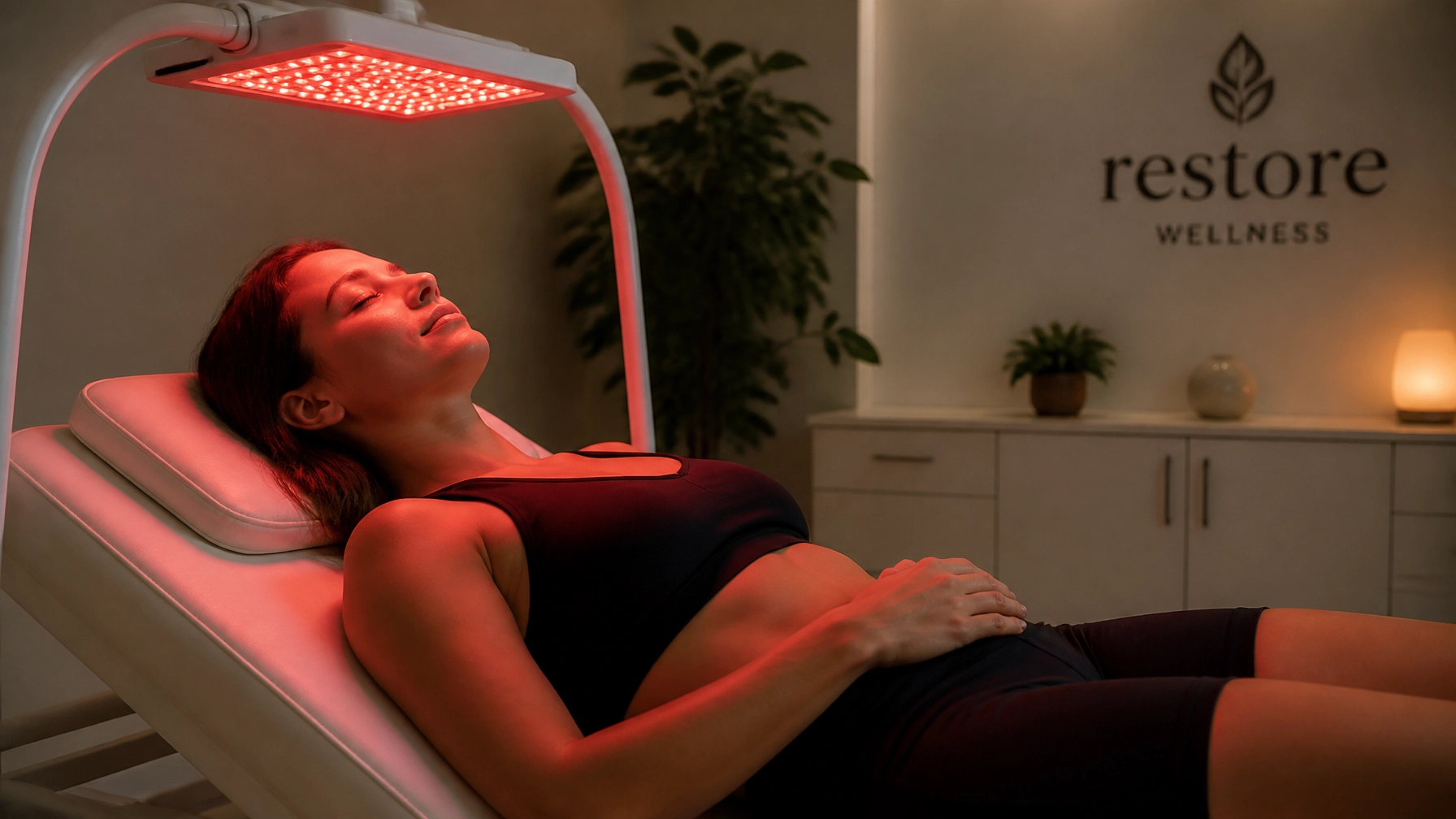
Gut health affects far more than digestion. Bloating, abdominal discomfort, irregular bowel habits, and chronic inflammation can influence sleep, energy, exercise, and overall quality of life.
This has led many people to ask: Can red light therapy help gut health, bloating, or IBS?
The honest answer in 2026 is that the idea is biologically interesting, but the direct human evidence is still early. Red and near-infrared light therapy, also called photobiomodulation, should not be presented as a proven cure for IBS or unexplained digestive symptoms.
It may support broader goals such as pain relief, inflammation management, recovery, and body contouring. Gut-specific treatment remains an emerging area of research.
What does light therapy have to do with the gut?
Red light therapy uses low-level red and near-infrared wavelengths to influence cellular activity. Light energy may interact with mitochondria, the structures that help cells produce energy.
Researchers are studying whether this process may:
- Support cellular energy production
- Influence oxidative stress
- Modulate inflammatory signalling
- Improve local circulation
- Support tissue repair
- Affect pain sensitivity and nerve signalling
The gut is connected to the nervous system, immune system, and microbiome through the gut–brain axis. Because of this, researchers are exploring whether photobiomodulation could influence more than the skin or muscles.
However, a possible mechanism is not the same as a proven treatment. Light applied to the abdomen does not automatically reach every part of the digestive tract, and different devices use different wavelengths, power levels, and treatment times.
Can red light therapy help IBS, bloating, or digestion?
At this stage, there is not enough high-quality human evidence to say that external red light therapy treats IBS, chronic bloating, constipation, diarrhea, or intestinal permeability.
A 2025 review in the Journal of the Korean Society of Laser Medicine and Surgery, titled “Photobiomodulation and its potential in treating irritable bowel syndrome”, explains why interest in this subject is growing. It discusses possible effects on inflammation, nerve sensitivity, the gut barrier, and the microbiome.
The same review also makes the research gap clear. Much of the evidence is preclinical, mechanistic, or based on small studies. Some research involves animal models or different forms of light therapy that are not the same as a full-body red light session at a wellness clinic.
Similarly, a PubMed-indexed systematic review and meta-analysis on transabdominal photobiomodulation found that the available evidence is still heterogeneous. More consistent, sham-controlled human trials are needed before abdominal photobiomodulation can be recommended as an established IBS treatment.
So, can red light therapy help gut health? Possibly, as an area for future research. Not yet as a proven IBS cure.
Bloating that is persistent, severe, new, or worsening should be assessed by a healthcare professional. The Cleveland Clinic’s IBS overview explains that IBS symptoms can overlap with other digestive conditions, making proper evaluation important.
How does photobiomodulation affect inflammation in the body?
Inflammation is one of the main reasons people search for “red light therapy for pain” or “red light therapy for inflammation.”
The red light therapy science is strongest in areas involving cellular recovery, localized discomfort, skin health, and some musculoskeletal applications. Depending on the condition and treatment protocol, photobiomodulation may influence inflammatory signals and support circulation in treated tissues.
That does not mean it removes all inflammation throughout the body. It also does not replace medical care for inflammatory bowel disease, infection, autoimmune conditions, or an acute abdominal problem.
For a broader explanation, Wave Therapy’s red light therapy Edmonton service page describes how red and near-infrared light are used in a non-invasive wellness setting.
Can it help with abdominal fat and waist circumference?
This is a separate question from gut health and IBS.
Some research suggests that targeted red and near-infrared light may support temporary changes in fat cells and modest reductions in localized circumference when used as part of a structured body-contouring program. These outcomes are cosmetic or metabolic in nature. They are not proof that the therapy improves digestion or treats intestinal inflammation.
Red light therapy should not be described as a way to “melt visceral fat,” cure obesity, or create dramatic weight loss without lifestyle changes.
For a balanced discussion, see Wave Therapy’s article on red light therapy and weight loss. It explains the difference between localized body contouring and whole-body weight loss.
Red light therapy may help support:
- Joint comfort
- Localized inflammation management
- Muscle recovery
- Post-exercise soreness
- Wound-healing support
- Skin rejuvenation
- Collagen production
- Fine-line and wrinkle reduction
- Skin tone and texture
- Skin firmness
- Cellulite appearance
- Localized body contouring
- Fat reduction support
- Metabolic wellness as part of a healthy lifestyle
- Hair growth support in some types of hair thinning
- General cellular recovery
- Relaxation and non-invasive wellness routines
- Gut-health research as an emerging, unproven application
- IBS symptom management as an investigational area, not an established treatment
Who is red light therapy for, and who should skip it?
Red light therapy may be appropriate for adults seeking a non-invasive wellness option for recovery, skin health, joint comfort, or body-contouring support.
It may be worth discussing with a healthcare professional before use if you:
- Are pregnant or breastfeeding
- Take photosensitizing medication
- Have a photosensitivity disorder
- Have lupus or another light-sensitive condition
- Have epilepsy or light-triggered migraines
- Have active cancer in the treatment area
- Recently had abdominal surgery
- Have unexplained or severe abdominal pain
- Have an active infection or acute illness
Use the eye protection recommended for the specific device. Do not look directly into bright LEDs, particularly during facial or full-body treatments.
Seek medical care promptly for abdominal pain with fever, vomiting, blood in the stool, jaundice, severe dehydration, unexplained weight loss, or rapidly increasing abdominal distension. Red light therapy is not appropriate for delaying an evaluation.
How many sessions before you notice anything?
There is no established session number for treating IBS or bloating because transabdominal red light therapy has not been proven for those conditions.
For other goals, results vary according to the condition, wavelength, treatment dose, lifestyle, and individual response. Many professional protocols use two or three sessions per week for several weeks. Some clients notice changes in relaxation, muscle comfort, or skin appearance relatively early. Body-contouring goals often require a longer series.
Wave Therapy materials commonly discuss visible results developing over approximately four to eight sessions, while some body-contouring protocols use eight to twelve sessions. These are general expectations, not guarantees.
More treatment is not always better. Consistency and appropriate dosing matter more than simply extending session time.
What does a session at Wave Therapy actually feel like?
A typical session is non-invasive. You remain clothed and stand or relax near an advanced red and near-infrared light system, depending on the treatment area.
Most people describe the light as warm and bright. A session should not feel painful, and there is generally no cutting, needles, or required downtime. Sessions may last approximately 15 to 20 minutes, although timing depends on the equipment and treatment plan.
A full-body session may be used for general recovery and wellness. If someone is specifically interested in abdominal treatment, the goal and safety considerations should be discussed before beginning. Wave Therapy should not be used to diagnose or treat unexplained digestive symptoms.
Some clients also combine light therapy with massage or other recovery-focused care. For massage provider referrals, you can explore Massage Quest. Wave Therapy’s sister company, Book a Therapy, also offers massage services that may complement a broader recovery routine.

Does red light therapy work? A practical answer
The answer depends on the goal.
For skin rejuvenation, muscle recovery, joint comfort, and some localized wellness applications, research is more developed than it is for gut-specific conditions. Even in better-studied areas, results are usually gradual and individual.
For IBS, bloating, and digestion, the responsible answer is more cautious:
- The biological theory is plausible.
- Early research is encouraging but limited.
- Direct human evidence remains insufficient.
- There is no established protocol for treating IBS with external red light.
- Red light therapy should not replace medical assessment or guideline-based IBS care.
You can also read Wave Therapy’s FAQ guide to red light therapy benefits, safety, and side effects before considering a session.
Practical takeaways
- Red light therapy may support cellular recovery, localized pain relief, skin health, and body contouring.
- Gut-health and IBS research is still early.
- Photobiomodulation is not a proven cure for IBS, bloating, or “leaky gut.”
- Abdominal fat reduction is a separate cosmetic and metabolic topic.
- Persistent or severe digestive symptoms should be assessed by a healthcare professional.
- Screen for photosensitivity, medication interactions, pregnancy, recent surgery, and other safety concerns.
- Follow the recommended treatment time and use appropriate eye protection.
- Choose a professional Edmonton provider that explains both benefits and limitations.
Quick FAQ
Is red light therapy proven to treat IBS?
No. Current evidence is not strong enough to call red light therapy a proven IBS treatment or cure.
Can red light therapy reduce bloating?
There is no convincing clinical evidence that external red light therapy reliably reduces bloating or abdominal distension.
Can red light therapy help gut inflammation?
It may influence inflammatory pathways in laboratory and early translational research, but this does not establish that it treats intestinal inflammation in people.
Is red light therapy for pain supported by research?
Photobiomodulation has a stronger evidence base for some localized pain, joint discomfort, and recovery applications than for IBS. Results depend on the condition and treatment protocol.
If you are curious about red light therapy in Edmonton, you can explore Wave Therapy sessions and book when ready. A calm consultation can help determine whether the treatment fits your goals.
Leave a Reply