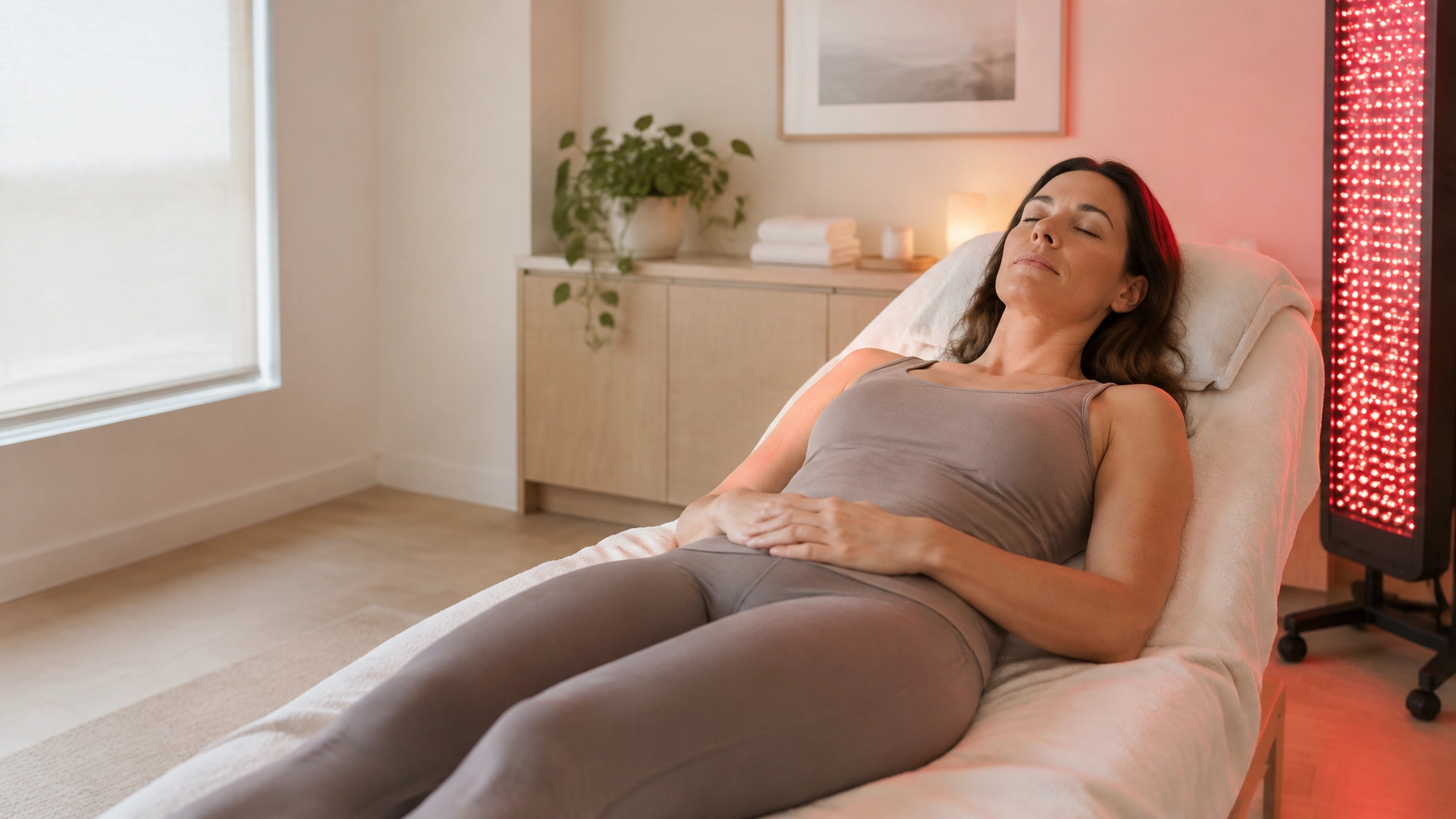
Stress is part of everyday life, and many people are looking for gentle ways to support their wellbeing. Red and near-infrared light therapy is often mentioned in conversations about mood, anxiety and cortisol, but what does the research actually show?
Here’s a clear look at the evidence, what a session may feel like, and where red light therapy fits among other wellness and mental-health supports.
Does red light therapy actually help with stress and anxiety, or is that just marketing?
The honest answer: it’s promising, but not proven as a general stress or anxiety treatment.
Some early research on photobiomodulation (PBM), the scientific term for using red or near-infrared light to affect biological tissue, has explored mood and anxiety. A 2025 systematic review in NeuroSci found encouraging results across some studies, but also noted that treatment methods and study populations varied, and many studies lacked strong control groups. That makes it difficult to know how much benefit to expect in everyday life.
So, red light therapy benefits for mood should be discussed cautiously. A relaxing session may feel restorative, but that experience is not the same as treating an anxiety disorder or proving a change in stress biology.
For more on the wider evidence, see Wave Therapy’s overview of what the 2026 research says about red light therapy science.
What does the science say about red light and cortisol?
Cortisol is a hormone involved in the body’s response to stress. It naturally changes throughout the day and can be affected by sleep, illness, medications, exercise and many other factors.
At present, there is not enough strong, repeatable human evidence to say that a typical full-body red light session reliably lowers cortisol or “balances” it. A calmer feeling after a session may be meaningful to the person experiencing it, but it does not prove cortisol has changed. One cortisol measurement also can’t, on its own, show that someone’s overall stress response has improved.
Researchers are still investigating how PBM may affect cells and nervous-system activity. The mechanism is not a confirmed cortisol treatment. As the Cleveland Clinic’s overview of red light therapy explains, evidence varies by use, and more well-designed research is needed for many claims.
How does light on the body differ from light on the head?
The location and equipment matter. They are not interchangeable treatments.
- Body-focused red or near-infrared sessions direct light toward areas such as the back, legs or skin. Research and wellness use may focus on effects in the exposed tissue.
- Transcranial photobiomodulation (tPBM) is a specific research approach that directs near-infrared light at areas of the head, using protocols intended to study brain-related effects.
- Different devices, wavelengths, power levels, session schedules and treatment targets can produce different exposures. Results from one setup should not be assumed to apply to another.
For example, one 2025 randomized study explored forehead tPBM in people receiving methadone maintenance treatment. That specific population and research protocol do not establish that ordinary full-body red light sessions will reduce anxiety for the general public. Wave Therapy in Edmonton offers full-body red and near-infrared wellness sessions; those are not the same as the specialized transcranial protocols used in brain research.

How many sessions before someone notices a calmer mood?
There is no proven number of sessions for feeling calmer, and how often to use red light therapy depends on the device, its instructions and the purpose of the session. Research protocols for transcranial treatment have varied from single sessions to repeated sessions over weeks. Those schedules are not universal recommendations for everyday wellness or full-body devices.
Some people may enjoy the quiet, warm-feeling pause of a session right away. Others may notice no particular mood change. If you choose to try red light therapy, treat it as an optional wellness experience rather than a guaranteed mental-health result. Follow the clinic’s guidance and the device protocol; more frequent or longer sessions are not automatically better.
Is red light therapy a replacement for therapy, medication or medical care?
No. Red light therapy is a supportive, non-invasive wellness tool, not a proven treatment for clinical anxiety or depression, and not a replacement for counselling, medication or care from a qualified health professional.
If anxiety is persistent, affects daily life or is getting worse, speak with a doctor or mental-health professional. Do not stop or change prescribed medication because of a light therapy session. For urgent mental-health support in Canada, call or text 988.
What it won’t do: Current evidence does not show that a regular full-body red light session diagnoses anxiety, reliably lowers cortisol, or replaces evidence-based mental-health care.
Can the relaxing session itself help, and is it safe to combine with massage?
A calm environment and time set aside to rest can feel helpful in their own right. That’s a reasonable personal benefit, but it doesn’t confirm a specific effect of light on anxiety or cortisol.
Some people choose to pair a light therapy session with massage as part of a broader relaxation routine. There is no established reason that a person who is otherwise suitable for both must avoid combining them, but tell both providers about your health conditions and preferences. Choose the order that feels comfortable, allow time to rest, and follow each provider’s safety guidance.
In Edmonton, you can explore massage services at Massage Quest or learn about massage through Wave Therapy’s sister company, Book a Therapy. Massage can be a complementary relaxation service, not a substitute for mental-health treatment.

Who should skip it or check with a doctor first?
Red light therapy side effects are generally considered uncommon when devices are used as directed, but “non-invasive” does not mean right for everyone. The Cleveland Clinic notes that misuse can harm skin or eyes, and that long-term safety information for some devices is limited.
Before booking or using a device, check with a healthcare professional if you:
- Have a condition that makes you sensitive to light, or take medication that may increase light sensitivity.
- Are pregnant, have an active cancer diagnosis, or are receiving cancer treatment.
- Have epilepsy or a history of light-triggered seizures, especially if a device uses pulsed light.
- Have an eye condition or would be exposing your face or head to light.
- Have a skin condition, open wound or other concern in the area being treated.
These are reasons to ask for individual advice, not a claim that every person with one of these circumstances will have a problem. Use appropriate eye protection, follow device directions and stop if you feel unwell or experience an unexpected reaction. Talk with a clinician if you are unsure whether a symptom needs medical attention.
What red light therapy may be explored for
Research into photobiomodulation varies by condition and treatment method. Areas studied or commonly explored include:
- Skin appearance and collagen support: evidence and suitability depend on the goal and device.
- Joint discomfort and inflammation: research is ongoing; results are not guaranteed.
- Muscle recovery: studied as a possible supportive approach, not a replacement for rest or medical care.
- Wound healing: specific applications may differ from general wellness sessions.
- Mood and anxiety symptoms: preliminary research, particularly involving specialized transcranial protocols; not an established treatment.
These are areas of investigation or wellness interest, not promises of results. For a broader discussion of claims and evidence, read Wave Therapy’s red light therapy research article.
Quick FAQ
Can red light therapy lower my cortisol?
There is not enough reliable evidence to say that standard full-body sessions lower cortisol in a meaningful or lasting way.
Will I feel calmer after one session?
You may find the session relaxing, but individual experiences vary and a calmer feeling is not proof of a clinical effect.
Is red light therapy safe?
It is generally considered low risk when used as directed, but eye protection and screening for relevant health conditions matter. Ask a clinician if you are unsure.
Is Wave Therapy’s full-body service the same as transcranial PBM?
No. Full-body wellness sessions are different from research protocols that target the head.
A practical takeaway
The current evidence offers a reason for continued research, not a reason to treat red light therapy as an anxiety or cortisol solution. If you’re curious, approach it as an optional wellness session, keep your expectations realistic, and continue any care recommended by your healthcare provider.
Wave Therapy is an Edmonton option for people exploring full-body red and near-infrared sessions. You can learn more about Wave Therapy or explore session booking when you’re ready.
Sources
- Woźniak J. et al. “Near-Infrared Stimulation in Psychiatry Disorders: A Systematic Review of Efficacy and Biological Mechanisms.” NeuroSci, 2025. PubMed Central
- Helali H. et al. “The effectiveness of Transcranial Photobiomodulation therapy (tPBM) on reducing anxiety, depression, and opioid craving in patients undergoing methadone maintenance treatment.” BMC Psychiatry, 2025. Springer Nature
- Cleveland Clinic. “Red Light Therapy: Benefits, Side Effects & Uses.” Cleveland Clinic
Leave a Reply