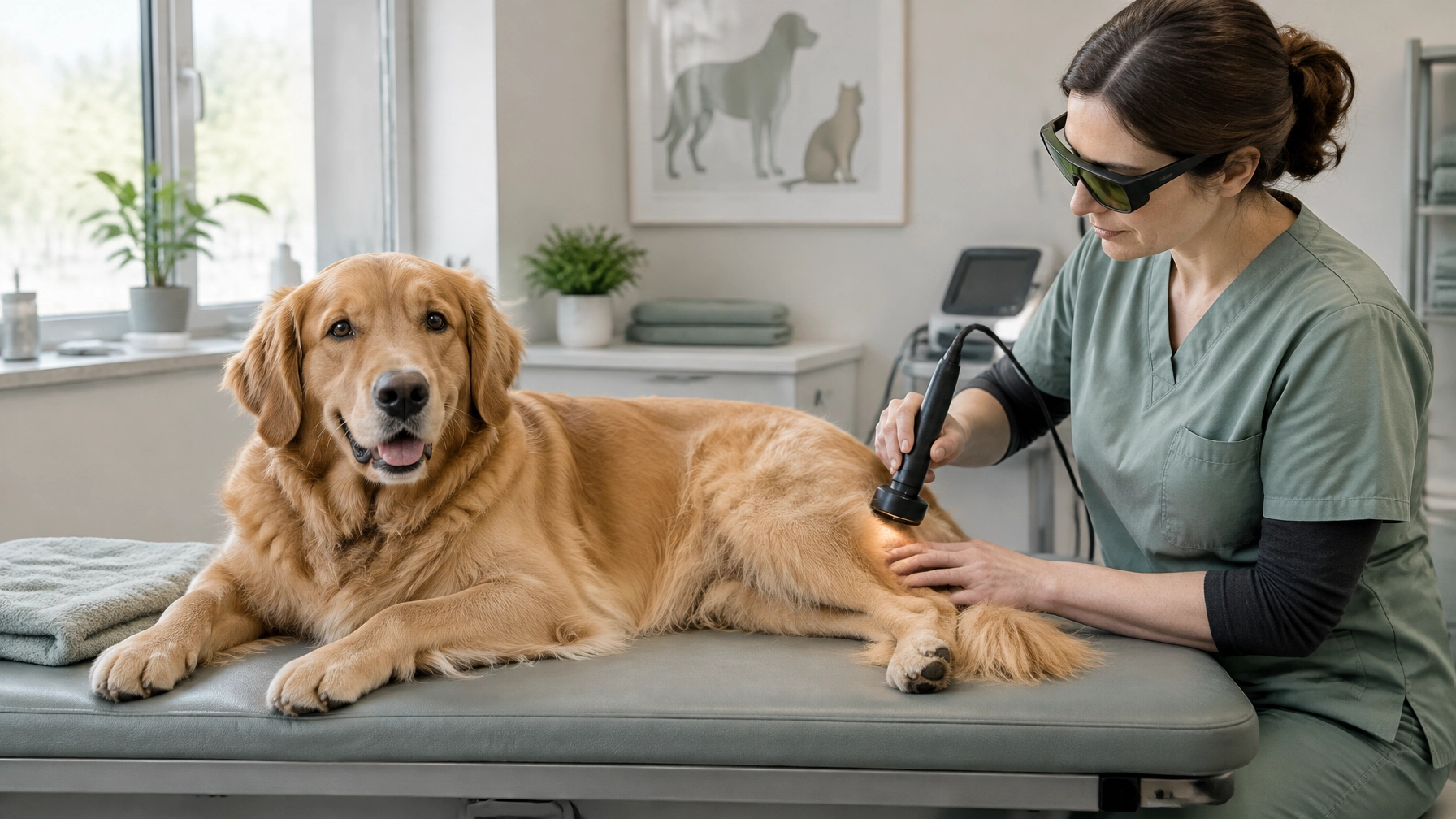
If you’re an Edmonton pet owner looking up red light therapy for dogs, you’ll find encouraging claims alongside plenty of unanswered questions. The clearest answer is that veterinary photobiomodulation, the clinical term often used for red and near-infrared light therapy, has some promising research, particularly for canine joint discomfort. But results depend on the condition and treatment protocol, and the evidence is not strong enough to assume every pet or device will benefit.
One important distinction: veterinary red light therapy is not the same service as a human wellness studio session. Wave Therapy serves people only. Pets cannot be booked for treatment at Wave Therapy; decisions about light therapy for an animal belong with its veterinarian.
What is red light therapy for dogs?
Photobiomodulation uses specific wavelengths of red or near-infrared light. In simple terms, light interacts with cells and may influence processes involved in energy use and inflammation. The proposed effect is not the same as heating tissue, but some higher-powered devices can create heat and carry burn risks.
“Red light therapy” covers different devices and settings. Wavelength, power, dose, treatment time, coat, and the depth of the target tissue all matter. A consumer panel, wearable, LED device and veterinary therapeutic laser are not interchangeable. The 2026 veterinary surgery review discusses how photobiomodulation is used in clinical veterinary settings, while also reflecting a field where protocols and evidence vary.

What does the research show for canine joint problems?
The most useful controlled evidence includes a small randomized, blinded, sham-controlled trial of 20 dogs with naturally occurring elbow osteoarthritis. The dogs received photobiomodulation or sham treatment over six weeks, alongside their existing veterinary care. The researchers reported better lameness scores in the active-treatment group, and nine of the 11 dogs in that group were able to reduce their anti-inflammatory medication dose during the study, compared with none in the sham group. These findings are encouraging, but the trial was small and focused on elbow osteoarthritis, not every joint problem or device. Read the canine elbow osteoarthritis study.
Some veterinary reporting describes improvements in mobility and range of motion for certain dogs. That should not be taken as a guaranteed outcome. A 2023 review also noted limitations in parts of the veterinary research, including small studies and incomplete reporting of treatment settings. The NBC Selected vet-reviewed overview provides helpful expert context, but it is not a substitute for clinical studies or individualized veterinary advice.
Does red light therapy help pet wounds or bone healing?
The evidence is mixed. A 2026 sham-controlled trial involving military working dogs with tail wounds found no significant improvement in wound healing from the tested light-therapy protocol. Many wounds were chronic or recurrent, and ongoing mechanical trauma may have affected healing. This result does not show that light therapy can never be useful for wounds; it does mean the tested approach did not demonstrate a benefit in that study. Read the 2026 tail-wound trial.
For bone healing after TPLO surgery, a procedure used to address a cranial cruciate ligament problem in dogs, the evidence is weak. Some research has explored postoperative comfort and function, but controlled studies have not established that photobiomodulation speeds radiographic bone healing. It should not be presented as a proven way to make an osteotomy heal faster.

Why shouldn’t I choose a pet device and try it on my own?
Because the right settings depend on the animal, the intended target and the specific device. A veterinarian or veterinary rehabilitation professional can help decide whether light therapy is appropriate, how it fits with other care, and how to reduce avoidable risks.
Wavelength is one consideration. As a broad guide, red wavelengths around 600–700 nm are generally used for more superficial targets such as skin, while near-infrared wavelengths around 780–950 nm may be selected for deeper tissues. These ranges are not a treatment plan. Your vet should guide wavelength, dose and duration for your pet and the device being considered.
Other factors matter too: fur and coat colour can affect how much light reaches the skin, and high-powered devices can create heat. “For pets” on a product label does not establish that its output or instructions are suitable for your animal.
Is red light therapy safe for dogs and other pets?
It may be tolerated when properly selected and supervised, but it is not risk-free. Eye exposure is a serious concern: never aim a device at an animal’s eyes, and follow veterinary guidance on suitable protective eyewear for the pet and people nearby. Near-infrared light may be invisible, so the absence of a visible beam does not mean there is no exposure.
High-powered devices can also cause thermal burns, especially if held too long in one spot or used without appropriate monitoring. Veterinary guidance is especially important before considering treatment near an active or suspected tumour, the thyroid, an area with reduced sensation, or active bleeding. Pregnancy and other health conditions may also affect whether treatment is appropriate. Your veterinarian can assess the risks for your pet rather than relying on general device instructions.
What should I ask my veterinarian?
Bring the device details or product link to the appointment, if you have one. Useful questions include:
- What might be causing my pet’s symptoms, and does the diagnosis need further assessment?
- Is photobiomodulation appropriate for this condition and for my pet?
- What outcome should we track, and how will we know whether the plan is helping?
- Which wavelength and dose are appropriate for the target tissue and this device?
- How long and how often should sessions be given, and who should administer them?
- What eye protection and temperature-monitoring steps are needed?
- Are there reasons to avoid light therapy given my pet’s health history?
- How should this fit with other recommended care, and when should we reassess?
When does my pet need professional care?
Arrange veterinary advice before starting light therapy, especially if your pet has ongoing pain, limping, a wound, or symptoms after surgery. Do not use a light device instead of an examination for new or worsening problems.
Seek prompt veterinary care if your pet:
- Suddenly cannot bear weight, appears severely painful, or has rapidly worsening symptoms.
- Has a deep, bleeding, infected-looking or non-healing wound.
- Develops swelling, discharge, a bad smell, or a change in behaviour after surgery.
- Shows new vision or eye symptoms after any light exposure.
- Seems weak, unusually lethargic, or otherwise seriously unwell.
These signs need professional assessment; a light session cannot identify their cause.
What does a veterinary session involve?
The veterinarian or rehabilitation professional should first consider your pet’s condition and decide whether treatment is suitable. If proceeding, they should explain the equipment, how the treatment will be delivered, how eyes will be protected, and what signs would mean stopping. Your pet’s comfort should be monitored throughout. The treatment may be considered alongside other veterinary care, rather than as a replacement for diagnosis, medication, rehabilitation or follow-up.

What’s the practical takeaway for Edmonton pet owners?
Red light therapy for dogs has promising but limited evidence. A small controlled study found improved lameness outcomes for dogs with elbow osteoarthritis, while a 2026 sham-controlled tail-wound trial found no significant healing benefit. Evidence that light therapy speeds bone healing after TPLO remains weak.
If you’re exploring red light therapy for pets in Edmonton, start with your veterinarian, not a device purchase. They can help you weigh the evidence, assess safety and decide whether a specific approach makes sense for your animal.
Wave Therapy is a separate, human-only wellness service in Edmonton. If you are interested in red light therapy for your own recovery or joint discomfort, you can learn about Wave Therapy, read about red light therapy and muscle recovery, see how red light therapy compares with massage for muscle recovery, or explore human session booking in Edmonton. Wave Therapy does not treat pets.
Prefer hands-on care for yourself? Massage Quest offers massage services, and our sister company Book a Therapy makes massage booking simple — both for humans, alongside the care your veterinarian provides for your pet.
Leave a Reply