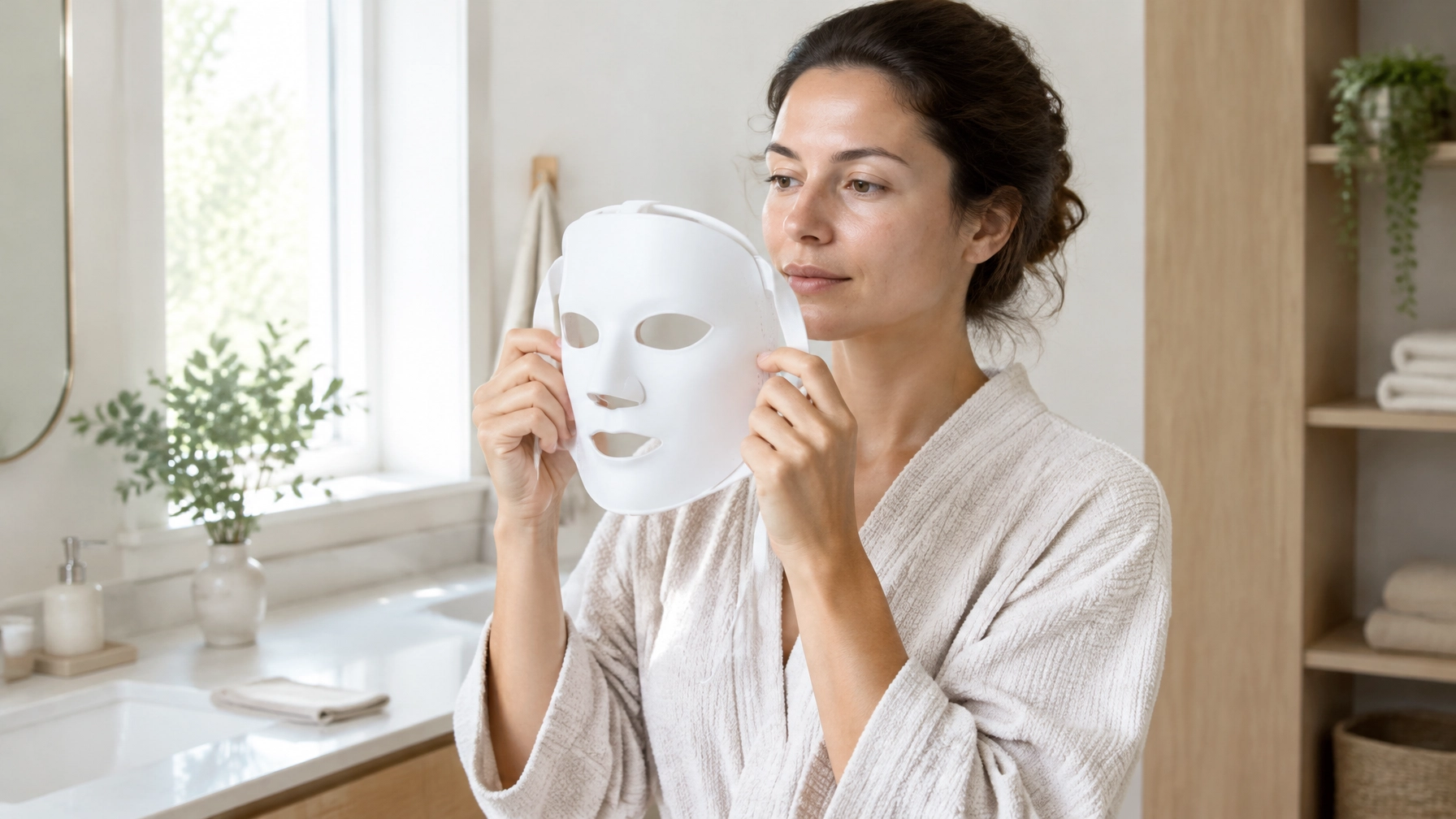
If you’re comparing LED face masks online with red light therapy sessions in Edmonton, start with the area you want to focus on. A mask is made to sit on your face. A full-body studio panel can expose several areas at once, including your face, neck, chest, back, joints and legs.
They aren’t two versions of the same product, and an at-home mask isn’t a cheaper version of a full-body session. The better choice depends on your goal, how you prefer to use light therapy and what you’ll realistically keep up with.
What’s the real difference between a mask and a studio session?
An LED face mask is a wearable, face-shaped device with a fixed coverage area. It’s designed for home use, often in short, repeated sessions. You can use it on your own schedule, without leaving the couch or booking an appointment.
A studio session uses a larger panel positioned in relation to the body. Depending on the setup and positioning, a session can cover areas a face mask simply can’t reach. That can matter if your interest includes a shoulder, knee, back or post-workout soreness across more than one area.
There’s an important evidence gap, too. A 2026 systematic review in Aesthetic Plastic Surgery examined eight studies of at-home LED devices for facial rejuvenation, involving 365 participants. The studies reported improvements in measures such as wrinkles, skin texture and elasticity. But none compared a home device directly with in-office LED therapy. So the current research doesn’t establish that one format is better for facial rejuvenation. Read the review.
What is an at-home mask genuinely good for?
A mask may suit someone who wants a face-only option and likes being able to use it at home. In the studies reviewed in 2026, treatment schedules varied: sessions lasted 3–21 minutes, two to seven times per week, over four to 12 weeks. That’s a wide range, not a universal routine. Follow the instructions for the specific device rather than assuming more use means better results.
What a mask is genuinely good for:
- Focusing light on facial skin, including areas such as the forehead and cheeks.
- Convenience: using a device at home without travel or appointment scheduling.
- A repeated routine, if you’re comfortable following the manufacturer’s recommended schedule.
- Exploring facial skin appearance goals such as texture or the appearance of fine lines, with modest expectations.
The review reported that adverse events were infrequent and usually mild and temporary, such as redness or irritation. That is reassuring, but it doesn’t mean every mask has the same design, dose or evidence behind it.

What is a studio session better for?
A studio session can make more sense when your goals go beyond facial skin. A face mask can’t reach a knee, shoulder or back. A larger panel offers broader coverage, although the areas exposed depend on how you’re positioned and the studio’s setup.
What a studio session is better for:
- Exposing more than the face in one visit, including areas such as the neck, chest, back, joints and legs.
- Exploring light exposure for broader wellness or recovery goals, rather than face-only use.
- Trying a session without first buying and learning to use a device yourself.
- Having guidance around positioning, session expectations and safety considerations.
A studio visit also takes time and planning, unlike using a mask at home. The best format is the one that fits what you want to focus on and how you prefer to make it part of your routine.
At Wave Therapy, clients can ask about red and near-infrared light sessions in Edmonton. The session format and current details are available through the Wave Therapy checkout page; check there for current pricing and session information rather than relying on assumptions.
What does the evidence say about skin results and acne?
The 2026 facial rejuvenation review found statistically significant improvements across several outcomes, including wrinkles, texture, elasticity and lines around the eyes. The included studies used different wavelengths and schedules, however, and reported light intensity and total dose inconsistently. The findings are encouraging, but they don’t tell us that every mask will produce the same outcome, or that a studio session will outperform one.
One trial included in the review found no difference between facial rejuvenation schedules of twice a week and three times a week. More frequent use isn’t automatically more effective.
For acne, a 2025 JAMA Dermatology systematic review found moderate-quality evidence supporting at-home blue light and red-blue combination devices for mild-to-moderate acne. That is not the same as evidence for a red-only anti-aging mask. Red light alone should not be assumed to provide the same acne support as a device designed for acne that uses blue light or a blue-red combination. If acne is cystic or scarring, see a physician rather than relying on a mask. Read the acne review.
For a plain-language overview of LED light therapy, see the Cleveland Clinic’s guide.
What should you check before buying a mask?
A product page should tell you more than how many LEDs it has or how many colours it offers. Wavelength, intensity, treatment time and safety instructions help describe what a device delivers. A 2026 product guide discusses irradiance, light power per area, and fluence, the total light energy delivered. It notes that dermatology applications commonly use irradiance in the range of 20–60 mW/cm² and fluence of 4–18 J/cm², while also highlighting inconsistent device reporting. Those ranges aren’t a guarantee that a mask will work for you. Read the guide.
Before you buy, check:
- Does the manufacturer clearly list the wavelengths and recommended use schedule?
- Does the device information explain its irradiance and fluence, and how those figures were measured?
- Are the eye-safety instructions clear and specific?
- Is there human clinical research relevant to this device or its intended use?
- Is the product making claims that sound much more certain than the evidence?
FDA 510(k) clearance is a safety and substantial-equivalence pathway. It is not proof that a device has demonstrated clinical effectiveness in a head-to-head trial. If a product’s specifications are vague or hard to find, treat that as a reason to pause and ask questions.
For broader context on how the formats differ, see Wave Therapy’s guide to at-home devices versus Edmonton studio sessions.
What about skin of colour, eye protection and medication?
The facial rejuvenation review notes that darker skin phenotypes were underrepresented in the available studies. It also raises a caution that blue light may worsen pigmentation for some people. If you have a history of pigment concerns or are considering a blue-light device, ask a dermatologist or other qualified healthcare professional for advice about your skin.
The review found that red and near-infrared photobiomodulation has not been shown to increase skin cancer risk. Still, if you have a history of skin cancer, check with your doctor before using a device.
Some medications can increase sensitivity to light. Ask your prescribing clinician or pharmacist whether your medication is photosensitizing before starting treatment. Follow the device or studio’s eye-protection guidance, especially for facial exposure. Wave Therapy has a practical eye protection safety guide.

How do you decide which option is worth it for you?
If your interest is limited to facial skin and you’re comfortable with a regular home routine, a mask may be a practical fit. If you’re looking for broader coverage, including areas outside the face, a studio panel is designed for a different job. You might also prefer the studio if you want to experience a session before deciding whether a home device suits you.
Neither option guarantees results. At Wave Therapy, clients may notice changes within 4–8 sessions, but individual results vary and that is not a promise. For a local overview of visit details, see red light therapy in Edmonton: cost, session length and what to expect. Confirm current pricing and session information on the checkout page.
Can light therapy fit into a broader recovery routine?
It can be one part of a wellness routine, alongside basics such as rest and movement. Massage is a separate hands-on service, not a replacement for light exposure. If you’re exploring massage in Edmonton, you can visit Massage Quest or Book a Therapy, Wave Therapy’s sister company for massage.

So, which is actually worth it?
Choose a mask when you want a face-only tool you can use at home. Choose a studio session when you’re interested in broader body coverage, or would rather try a session before investing in a device. Neither is automatically the better value because they’re not designed for the same job.
If you’re considering a full-body red light therapy session in Edmonton, review current details and book a session through Wave Therapy’s checkout page when you’re ready.
Leave a Reply