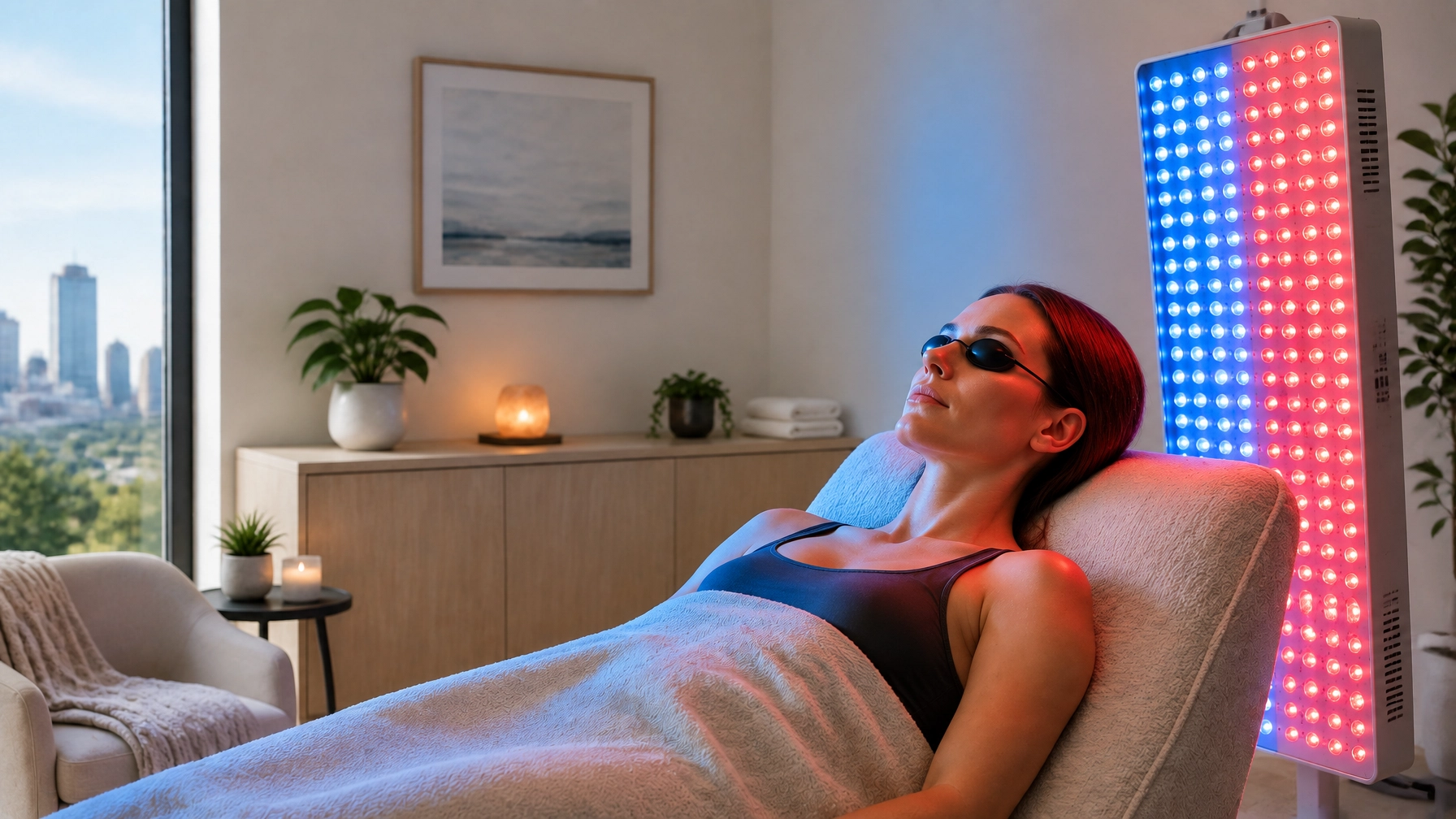
Blue light and red light therapy are often discussed as though they do the same thing. They do not.
The better choice depends on your goal. Blue light has a more specific role in mild-to-moderate inflammatory acne. Red and near-infrared light are more relevant to skin rejuvenation, fine lines, inflammation, tissue repair and recovery.
Rosacea is different. Because rosacea-prone skin can flush easily, neither blue nor red light should be presented as a proven treatment without medical guidance.
Here is a practical, evidence-aware comparison.
What is the difference between blue light and red light therapy?
| Light type | Common wavelength | Main depth and purpose |
|---|---|---|
| Blue light | Around 415 nm | Works mostly near the skin’s surface and targets acne-associated bacteria |
| Red light | Around 630–660 nm | Reaches further into skin tissue and supports cellular signalling, inflammation control and collagen activity |
| Near-infrared light | Often around 800–850 nm | Reaches deeper tissue and is commonly used for recovery, discomfort and deeper inflammation |
Blue light is absorbed by porphyrins produced by Cutibacterium acnes, the bacteria associated with acne. This interaction can generate reactive oxygen species that damage the bacteria. The effect is mainly superficial. [1][2]
Red light works through a different process called photobiomodulation. It interacts with cellular structures, including mitochondria, and may support energy production, collagen activity, circulation and tissue repair. Near-infrared light penetrates deeper than visible red light. [3][4]

Does blue light therapy work better for acne?
For mild-to-moderate inflammatory acne, blue light has the more specific role.
Studies have examined blue light around 415 nm for papules and pustules. Blue light may reduce acne-causing bacteria and can sometimes reduce inflammation and oiliness. However, the evidence is not perfect. Studies have used different devices, doses and treatment schedules, and many have been relatively small.
Combination blue-and-red devices exist because the wavelengths may complement each other:
- Blue light targets acne-associated bacteria near the surface.
- Red light may help calm inflammation.
- Red light may support the skin’s recovery after breakouts.
- Combination protocols may address more than one part of the acne process.
A frequently cited clinical trial found that combined blue and red light reduced inflammatory acne lesions over a 12-week period. The treatment was gradual, not immediate. [2]
The practical answer is:
- Mild inflammatory acne: Blue or blue-and-red light may be worth discussing.
- Blackheads and congestion: Results may be less predictable.
- Acne scarring: Blue light is not a primary scar-removal treatment.
- Moderate-to-severe, painful or cystic acne: See a dermatologist rather than relying on LED therapy alone.
Blue light can be an adjunct. It should not replace proven medical acne treatments when those treatments are needed.
Is red light better for wrinkles and skin rejuvenation?
Yes. Red and near-infrared light are the more relevant wavelengths for wrinkles, texture and signs of skin aging.
Red light therapy may support:
- Collagen production and dermal collagen density.
- The appearance of fine lines.
- Skin texture and elasticity.
- Recovery from minor irritation or surface damage.
- General skin rejuvenation.
The results are usually subtle and progressive. Red light is not comparable to an ablative laser, injectable treatment or surgical procedure. It is a gentler option that may support gradual improvements with regular use.
A controlled study published in Photomedicine and Laser Surgery reported improvements in fine lines, wrinkles, skin roughness and collagen density following red and near-infrared light treatments. [5]
For a deeper explanation of the current evidence, read Wave Therapy’s guide to whether red light therapy is scientifically proven.
What about red light therapy for rosacea?
Rosacea is the most misunderstood part of this comparison.
Rosacea is not simply “sensitive skin.” It can involve flushing, persistent redness, visible blood vessels, burning, stinging and acne-like bumps. Common triggers include heat, temperature changes, alcohol, spicy food, stress, sunlight and irritating skincare products.
Light therapy is often marketed for rosacea, but that does not mean blue or red light is an established rosacea treatment.
Both wavelengths may be the wrong choice for some people:
- Blue light can be irritating for reactive skin and may be a concern for people who develop pigmentation easily.
- Red light may support inflammation control in some settings, but it can also be associated with warmth or increased local circulation.
- Heat and vasodilation can worsen flushing in certain people.
- Evidence for LED therapy specifically treating rosacea remains limited compared with the evidence for standard medical care and dermatologist-directed vascular treatments. [1][6]
If your primary concern is rosacea redness or flushing, speak with a dermatologist before starting sessions. Stop if you notice burning, persistent redness, swelling or a clear worsening of symptoms.
What are blue light therapy’s downsides?
Blue light is not automatically dangerous, but it is not ideal for every person or every goal.
Potential concerns include:
- Pigmentation: Visible blue light can stimulate pigment pathways, particularly in people with medium to deep skin tones or a history of melasma and post-inflammatory hyperpigmentation. Direct evidence for low-dose acne LED devices is still limited, so this is an area for caution rather than certainty. [7]
- Eye discomfort: Bright blue light can cause glare, eye strain or discomfort. Follow the device instructions and use appropriate eye protection.
- Sleep timing: Bright blue light exposure near bedtime may affect circadian timing and sleep for some people. If you are sensitive to evening blue light, schedule treatment earlier in the day. [8]
- Limited versatility: Blue light is not the wavelength to choose for muscle recovery, deeper joint discomfort, collagen support or hair growth. Evidence for those applications generally concerns red or near-infrared light, not acne-focused blue light.
Anyone with a photosensitive condition or who takes photosensitizing medication should ask a healthcare professional before using light therapy.
What are red light therapy’s limits and side effects?
The answer to “does red light therapy work?” is condition-specific.
Red light therapy is not a proven cure for every condition marketed online. Results vary based on:
- Wavelength accuracy.
- Irradiance and dose.
- Treatment distance.
- Session length.
- Frequency and consistency.
- The condition being treated.
- Individual response.
Short-term side effects are usually mild when a suitable device is used correctly. They can include temporary redness, dryness, tightness, itching, warmth or eye discomfort. Cleveland Clinic notes that long-term safety data for some devices remain limited and advises discussing treatment with a healthcare provider, especially for a specific skin condition. [1]
For a comparison of red and near-infrared wavelengths, see Wave Therapy’s guide to red light versus infrared light therapy.
What conditions may red and near-infrared light therapy support?
Evidence varies by condition. Red light therapy should be viewed as supportive care, not a guaranteed treatment.
- Skin rejuvenation.
- Fine lines and wrinkles.
- Uneven-looking skin texture.
- Collagen support.
- Minor wound-healing support.
- Muscle recovery after exercise.
- Joint discomfort and inflammation.
- General recovery and relaxation.
- Hair-growth support in selected hair-loss conditions.
- The appearance of cellulite.
- Skin tightening support.
- Fat-loss or body-contouring support, where expectations should remain modest.
- Surface-level tissue repair.
Cleveland Clinic also emphasizes that more high-quality research is needed for many advertised uses. [1]
How many sessions do you need?
There is no universal number because devices and goals differ.
For acne, clinical protocols commonly use blue or blue-and-red light several times per week over approximately four to eight weeks, with clearer assessment after consistent use.
For red and near-infrared treatments, many people notice gradual changes after four to eight sessions. More visible changes in skin texture and collagen-related appearance may take eight to twelve weeks or longer.
At Wave Therapy in Edmonton, many clients report visible changes within roughly four to eight sessions, although individual results vary. Sessions are non-invasive and designed to fit into a regular wellness routine.

What should you choose: blue, red or both?
Start with the goal, not the marketing.
- Active inflammatory acne: Blue or blue-and-red light may be the most relevant option.
- Wrinkles, texture and skin rejuvenation: Red and near-infrared light are more appropriate.
- Muscle recovery or joint discomfort: Red and near-infrared light are generally the wavelengths discussed.
- Rosacea flushing: Get medical guidance first. Do not assume either blue or red light will treat it.
- Pigmentation concerns: Discuss visible-light exposure with a dermatologist, especially if your skin tends to develop melasma or dark marks.
Wave Therapy provides red and near-infrared sessions rather than blue-light acne treatment. Its Edmonton services are focused on non-invasive wellness applications such as skin rejuvenation, recovery and support for discomfort.
Some clients also combine light therapy with massage or other recovery services. You can explore options through Massage Quest or Book a Therapy.
When should you see a doctor or dermatologist?
Seek professional advice before continuing light therapy if you have:
- Painful, cystic or rapidly worsening acne.
- Persistent facial flushing or suspected rosacea.
- New or worsening pigmentation.
- Significant burning, swelling or rash.
- A photosensitive condition.
- A medication that increases light sensitivity.
- A history of skin cancer or an unexplained skin lesion.
- Symptoms that do not improve after a consistent trial.
The sensible approach is to match the wavelength to the concern, use realistic expectations and involve a qualified professional when the diagnosis is uncertain.
If you are exploring red light therapy in Edmonton for recovery, discomfort or skin rejuvenation, you can learn more about Wave Therapy and explore sessions when you are ready.
Sources
- Cleveland Clinic. Red Light Therapy.
- Papageorgiou P, Katsambas A, Chu A. “Phototherapy with blue and red light in the treatment of acne vulgaris.” PubMed.
- Jagdeo J, Austin E, Mamalis A, et al. “Light-emitting diodes in dermatology: A systematic review of randomized controlled trials.” PubMed.
- Avci P, Gupta A, Sadasivam M, et al. “Low-level laser (light) therapy in skin: stimulating, healing, restoring.” PMC.
- Wunsch A, Matuschka K. “A controlled trial to determine the efficacy of red and near-infrared light treatment.” PMC.
- American Academy of Dermatology. Rosacea: Lasers and lights.
- Mahmoud BH, et al. Research on visible light and pigmentation, including skin of color considerations. PMC.
- Healthline. Blue light therapy.
Leave a Reply