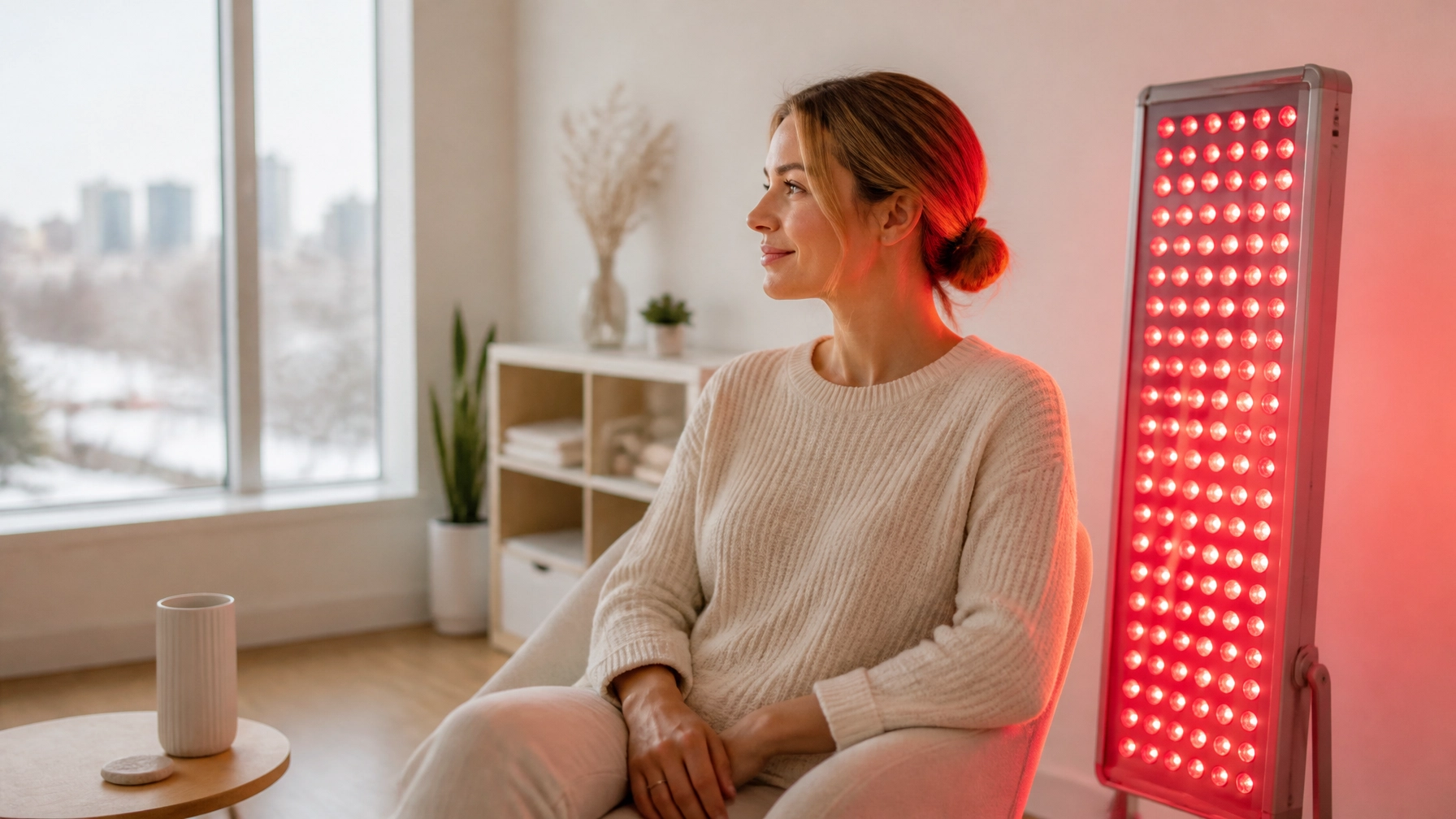
As Edmonton moves into September, daylight begins to fade earlier. By the middle of winter, shorter days and longer nights can affect energy, sleep, motivation, and mood.
That raises a common question: Can red light therapy help with seasonal affective disorder, low mood, or the fall and winter blues?
The most accurate answer is nuanced:
Red light therapy is not a direct replacement for bright light therapy, the standard evidence-backed light treatment for SAD. However, red and near-infrared light may support cellular energy, recovery, sleep, and general wellness. Early research on a specialized treatment called transcranial photobiomodulation is also exploring possible effects on depression.
Those are different uses, with different levels of evidence.
What is seasonal affective disorder?
Seasonal affective disorder, or SAD, is a form of depression that follows a seasonal pattern. It most often begins in fall or winter and improves during spring or summer.
Possible symptoms include:
- Persistent low mood
- Reduced interest in normal activities
- Low energy
- Sleeping more than usual
- Changes in appetite
- Difficulty concentrating
- Social withdrawal
- Feelings of hopelessness or worthlessness
Having a few difficult days during a dark Edmonton winter does not automatically mean you have SAD. Still, persistent or worsening symptoms deserve attention. A doctor or mental health professional can help distinguish SAD from depression, anxiety, sleep problems, thyroid conditions, medication effects, or other health concerns.
Bright light therapy and red light therapy are not the same
This is the most important distinction.
Bright light therapy for SAD
Bright light therapy uses a specialized light box that typically delivers 10,000 lux of cool-white or broad-spectrum light. The user sits near the box with their eyes open, without staring directly at the bulbs.
A common clinical approach is:
- Approximately 20–30 minutes each morning
- Shortly after waking
- At the distance recommended by the manufacturer
- Used consistently during the fall and winter season
Bright light therapy works primarily through the eyes. Light-sensitive cells in the retina communicate with the brain’s circadian system, helping regulate the body clock and sleep-wake timing.
The National Center for Complementary and Integrative Health explains that bright light therapy is the best-studied light-based treatment for SAD.
Red light therapy
Red light therapy, also called photobiomodulation, generally uses red wavelengths around 600–700 nanometres and near-infrared wavelengths around 800–900 nanometres.
Professional systems are commonly used on the body, skin, muscles, and joints. They are not designed to provide the same eye-level intensity or circadian stimulus as a 10,000-lux SAD light box.
In simple terms:
| Bright light therapy | Red light therapy |
|---|---|
| Usually around 10,000 lux | Measured by wavelength, irradiance, and dose |
| Primarily targets the eyes and circadian system | Commonly targets skin and body tissues |
| Evidence-backed treatment for SAD | Not an established replacement for SAD treatment |
| Usually used in the morning | Timing depends on the wellness goal and individual response |
A red light panel may look bright, but visual brightness is not the same as lux at the eyes. It should not automatically be treated as a SAD light box.

What does red light therapy do at the cellular level?
The red light therapy science is still developing, but researchers believe red and near-infrared wavelengths may interact with cellular structures called mitochondria.
Mitochondria help cells produce energy. Photobiomodulation may influence mitochondrial activity, cellular signalling, circulation, inflammation, and tissue repair.
The proposed effects include:
- Supporting cellular energy production
- Helping regulate inflammatory responses
- Supporting muscle recovery
- Encouraging tissue repair
- Supporting collagen activity in the skin
- Promoting relaxation when discomfort or muscle tension affects rest
A review of photobiomodulation mechanisms published through PubMed Central discusses how red and near-infrared light may affect mitochondrial and inflammatory pathways.
This does not mean red light therapy treats depression directly. It means there are biological reasons researchers are studying whether photobiomodulation could influence areas related to mood, sleep, inflammation, and brain function.
Can red light therapy help with mood or the winter blues?
For general mood and the winter blues, the evidence is not strong enough to make a treatment claim.
Some people may find a red light therapy session calming. Others may appreciate the routine, gentle warmth, or recovery support. If muscle soreness or joint discomfort is making it harder to sleep, reducing that discomfort may indirectly help you feel better during the day.
Red light therapy may also support sleep for some people, although the research remains limited and mixed. Wave Therapy’s guide to red light therapy and sleep explains what is currently known about sleep quality, evening routines, and realistic expectations.
However, a relaxing wellness experience is not the same as treating SAD or clinical depression. If you have ongoing low mood, loss of interest, hopelessness, or difficulty functioning, professional assessment should come first.
What is transcranial photobiomodulation?
Transcranial photobiomodulation, or tPBM, is a specialized and still experimental application of near-infrared light.
Instead of treating the body with a full-body panel, tPBM applies near-infrared light to areas of the head, often near the forehead or prefrontal cortex. Researchers are investigating whether this may influence:
- Brain energy metabolism
- Cerebral blood flow
- Neuroinflammation
- Mitochondrial function
- Neural signalling
Early studies of tPBM for major depression have produced promising findings. A 2024 systematic review and meta-analysis in Frontiers in Psychiatry reported an overall reduction in depressive symptoms across several photobiomodulation trials.
But the evidence has important limitations:
- Many studies are small.
- Treatment devices and doses differ.
- Some trials are open-label or lack strong control groups.
- More rigorous randomized trials have produced mixed or null results.
- The ideal wavelength, dose, treatment schedule, and target area are not yet established.
For that reason, tPBM should be viewed as an emerging research area: not as a proven replacement for psychotherapy, medication, bright light therapy, or medical care.
It is also important not to confuse a professional full-body red light session with a research protocol designed specifically for transcranial treatment. They are not interchangeable.
So, does red light therapy work for SAD?
At this time, there is not enough evidence to say that standard red light therapy treats seasonal affective disorder.
If SAD is your main concern, the better-supported approach is to discuss evidence-based options with a healthcare professional. These may include:
- A properly selected 10,000-lux bright light box
- Cognitive behavioural therapy
- Medication when appropriate
- Sleep and circadian-rhythm support
- Regular outdoor activity during daylight
- Treatment of related health conditions
The Mayo Clinic’s SAD treatment overview provides practical information about bright light therapy and other standard treatment options.
Red light therapy may fit into a broader wellness routine for sleep, recovery, muscle tension, skin health, or general relaxation. It should not replace the treatment most supported for SAD.
Who may benefit from red light therapy in Edmonton?
A professional red light therapy session may be worth exploring if you are interested in non-invasive support for:
- Muscle recovery during winter training
- Joint stiffness or everyday discomfort
- Skin rejuvenation and collagen support
- Relaxation and recovery
- General wellness during darker months
- A consistent self-care routine
Wave Therapy offers full-body red and near-infrared light sessions in Edmonton. Sessions are generally quiet and non-invasive, with many clients experiencing gentle warmth and no required downtime.

If winter muscle tension or physical discomfort is affecting your sleep, massage may also be part of a broader recovery routine. You can explore local provider and referral options through Massage Quest or visit Book-a-Therapy, Wave Therapy’s sister company for massage services.
These services may support relaxation and physical comfort, but they are not substitutes for mental health treatment when depression symptoms are present.
Who should consult a doctor before light therapy?
Speak with a doctor, pharmacist, or mental health professional before beginning bright light therapy or red light therapy if you:
- Have bipolar disorder or a history of mania or hypomania
- Take medication that increases sensitivity to light
- Have significant eye disease or a recent eye procedure
- Have a photosensitive medical condition
- Have a light-triggered seizure disorder
- Are pregnant or breastfeeding
- Have severe or persistent sleep disruption
- Are being treated for depression or another mental health condition
Bright light therapy can occasionally cause headaches, eye strain, agitation, or changes in sleep. In people with bipolar disorder, it may contribute to mood elevation. Red light therapy is generally well tolerated when used correctly, but it is not risk-free and should be used according to the provider’s instructions.
Wave Therapy’s guide to red light therapy safety and side effects offers more information about eye protection, medications, and sensible treatment parameters.
If you experience severe depression, feel unsafe, or have thoughts of self-harm, seek urgent help. In Canada, you can call or text 988 for suicide crisis support, or call 911 in an emergency.
What should you expect from a Wave Therapy session?
A full-body session typically involves positioning yourself near a professional red and near-infrared light system for a controlled period of time.
You can generally expect:
- A short discussion about your goals and relevant health considerations.
- Instructions about positioning and eye protection.
- Gentle warmth and a bright red glow during treatment.
- No needles, incisions, or invasive procedures.
- A return to normal activities afterward for most people.
The goal is not to promise a dramatic mood change after one visit. A more realistic expectation is a calm, structured wellness session that may support recovery, comfort, skin health, and relaxation over time.
The practical takeaway
If you are asking, “Can red light therapy help with SAD?”, the responsible answer is:
Not as a replacement for bright light therapy.
Bright light therapy using a properly specified 10,000-lux light box remains the standard light-based treatment for SAD. Red light therapy works differently. It may support cellular energy, inflammation regulation, sleep, recovery, and general wellness, but direct evidence for treating SAD is currently limited.
Near-infrared transcranial photobiomodulation is a promising area of research for depression, but it remains experimental and should not replace professional mental health care.
If you are curious about red light therapy in Edmonton, you can learn more about Wave Therapy’s full-body red and near-infrared sessions or explore current Edmonton booking options when you are ready.
Sources and further reading
- National Center for Complementary and Integrative Health: Seasonal Affective Disorder and Complementary Health Approaches
- Mayo Clinic: Seasonal Affective Disorder Treatment
- Ji et al.: Photobiomodulation for depression: systematic review and meta-analysis, PubMed Central
- Mechanisms and Applications of the Anti-Inflammatory Effects of Photobiomodulation, PubMed Central
- American Psychiatric Association: Bright Light Therapy Beyond Seasonal Depression
Leave a Reply