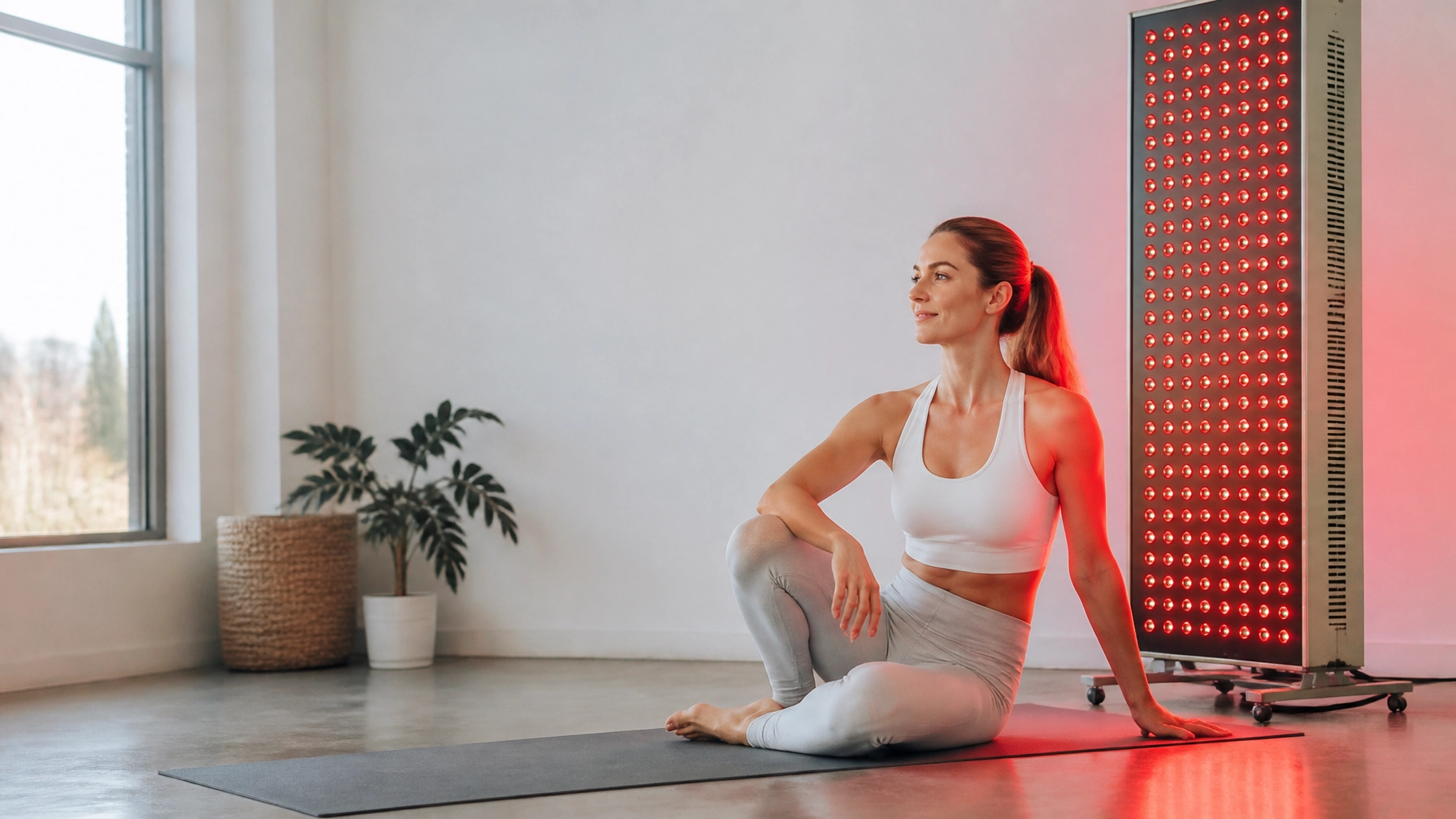
If you have ever felt stiff, sore, or unusually fatigued after a workout, you may have wondered whether red light therapy can help your muscles recover faster.
The short answer is: possibly, for some people. Research suggests that photobiomodulation, another name for red and near-infrared light therapy, may reduce delayed-onset muscle soreness, support muscle function, and influence markers associated with exercise-related muscle damage.
The results are not guaranteed. They depend on the wavelength, dose, timing, treatment area, and your overall recovery habits.
Here is what the current evidence says about red light therapy for muscle recovery, including when to use it, how often to train with it, and what to expect from a professional session in Edmonton.
Does red light therapy actually speed up muscle recovery?
It may help support recovery, but it should not be viewed as a replacement for sleep, nutrition, rest, or proper training.
Muscle recovery involves more than soreness. Your body must restore energy, manage inflammation, repair small amounts of tissue stress, and return muscle strength and coordination to normal.
Studies on photobiomodulation have reported potential improvements in:
- Delayed-onset muscle soreness, or DOMS
- Temporary muscle fatigue
- Recovery of strength after demanding exercise
- Markers such as creatine kinase, which may increase after muscle damage
- The ability to return to normal training
However, not every study has found a meaningful benefit. Differences in devices and treatment protocols make the evidence difficult to compare directly.
A 2017 randomized, double-blind study published in the Journal of Athletic Training compared three commercially available phototherapy devices in 40 healthy men after strenuous eccentric exercise. The low-powered pulsed light group experienced less soreness and better maintenance of muscle force than the placebo and some other treatment groups. The high-powered continuous device did not produce the same benefits. This is a useful reminder that more powerful light is not automatically more effective. (De Marchi et al., 2017)
The most realistic conclusion is that red light therapy may provide a modest recovery advantage for some people, particularly when it is used consistently and with an appropriate protocol.

How does red light therapy work at the cellular level?
Red and near-infrared light may interact with structures inside cells called mitochondria. Mitochondria help produce adenosine triphosphate, or ATP, which cells use for energy.
In simple terms, photobiomodulation may give cells a light-based signal that supports normal energy production and repair processes.
Researchers are studying several possible effects, including:
- Supporting mitochondrial activity
- Encouraging local circulation
- Influencing nitric oxide signalling
- Helping regulate the inflammatory response
- Reducing oxidative stress in certain circumstances
- Supporting tissue repair and muscle function
Near-infrared light generally penetrates farther into tissue than visible red light. This is why systems designed for muscle recovery, joint comfort, and deeper tissue support often include near-infrared wavelengths.
The process is not the same as heating the muscles like a sauna or hot pack. Red light therapy uses specific non-UV wavelengths at low levels. Most people experience gentle warmth, but the biological response depends on the dose delivered.
A systematic review and meta-analysis published in Lasers in Medical Science examined phototherapy studies involving exercise performance and recovery. The review found the most consistent results when red or infrared light was applied before exercise, although the authors also noted variation between studies. (Leal-Junior et al., 2015)
When should you use red light therapy : before or after a workout?
Both pre-workout and post-workout sessions have been studied. The best choice depends on your goal and the type of training you do.
Using red light therapy before exercise
Some research suggests that applying photobiomodulation before exercise may help muscles tolerate demanding activity. Potential goals include:
- Supporting muscle performance
- Delaying fatigue
- Reducing the amount of exercise-related muscle stress
- Preparing a muscle group for a difficult session
The systematic review by Leal-Junior and colleagues found that many of the positive studies applied light before exercise. However, many of those studies used targeted devices, specific doses, and carefully controlled protocols. You should not assume that any red light panel will produce the same outcome.
Pre-workout treatment may be most relevant before:
- Heavy resistance training
- High-intensity intervals
- Long runs or cycling sessions
- Competition or athletic events
- A workout involving a muscle group that is still mildly fatigued
Using red light therapy after exercise
Post-workout use is often chosen to support relaxation, comfort, and recovery after training. It may be useful when your main concern is soreness or stiffness rather than immediate performance.
A post-workout session may fit well after:
- Strength training
- A long endurance workout
- Recreational sports
- Hiking or physically demanding work
- A return to exercise after a break
There is no need to rush into a session immediately after every workout. Consistency and appropriate dosing matter more than treating yourself for as long as possible.
For a practical local perspective, see Wave Therapy’s guide on red light therapy for muscle recovery for Edmonton athletes, or compare it with red light therapy vs. massage for muscle recovery.
How often should you train with it?
There is no universal red light therapy schedule for every person or device.
For general muscle recovery, many people begin with two to three sessions per week. More frequent use may be appropriate for some equipment and training schedules, but it should follow the provider’s or manufacturer’s instructions.
A sensible routine may look like:
- Use a consistent session length.
- Treat the main muscle groups involved in your training.
- Apply the therapy before or after harder workouts.
- Continue for several weeks before judging the result.
- Track soreness, mobility, and training comfort.
- Avoid doubling the session length to make up for a missed appointment.
Some studies use targeted doses measured in joules per point or joules per square centimetre. Professional systems and home devices can differ significantly in irradiance, coverage, wavelength, and treatment time.
This is why “How long should I sit under the lights?” cannot be answered without knowing which system is being used.
Wave Therapy’s guide to how often to use red light therapy provides additional information about frequency, consistency, and realistic expectations.

What does the science say about red light therapy benefits?
The science is promising but not definitive.
The strongest potential benefits for active adults appear to involve:
- Less perceived muscle soreness
- Faster return of strength after strenuous exercise
- Support for muscle function
- Reduced levels of certain exercise-related damage markers
- Potential support for training consistency
The 2015 systematic review included 13 randomized controlled trials of acceptable quality. Twelve applied phototherapy before exercise, and several reported improvements in performance or recovery-related outcomes.
That does not mean every person will recover faster after every session. Many studies involved small groups, specific muscle groups, and specialized devices. Some tested laser and LED combinations that may not match consumer products or full-body systems.
The evidence also does not prove that red light therapy builds muscle by itself. Muscle growth still depends primarily on progressive training, adequate protein and calories, recovery, and time.
A balanced approach is to consider red light therapy an adjunct. It may support the recovery process, but it does not replace a well-designed training program.
For another overview of what red light therapy may and may not help with, read Healthline’s medically reviewed red light therapy guide. Healthline notes that red light therapy is generally painless and well tolerated when used correctly, while also emphasizing that more research is needed for many advertised benefits.
Is red light therapy safe for muscle recovery?
Red light therapy is generally considered low risk when used as directed. It is non-invasive and does not use ultraviolet light.
Possible short-term effects may include:
- Mild warmth
- Temporary redness
- Skin sensitivity
- Eye strain or discomfort
- Headache from bright light
- Temporary irritation if the dose is too high
More exposure is not automatically better. Photobiomodulation may follow a biphasic dose response, which means that too little light may do very little, while excessive exposure may reduce the benefit or irritate the skin.
Follow the equipment instructions and avoid staring directly into bright LEDs. Use protective eyewear when recommended.
Speak with a doctor or pharmacist before treatment if you:
- Take medication that increases sensitivity to light
- Have a photosensitive condition
- Have a significant eye condition
- Are pregnant or breastfeeding
- Have active cancer or an unexplained lesion in the treatment area
- Have recently had surgery or a significant injury
- Have severe, persistent, or unexplained muscle pain
Seek medical care instead of relying on light therapy if you have severe swelling, sudden weakness, dark urine, loss of sensation, chest pain, difficulty breathing, or pain after a major injury.
Who is red light therapy for muscle recovery most suitable for?
It may be worth exploring if you are:
- A recreational athlete managing regular post-workout soreness
- Returning to exercise after time away
- Training for a race or event
- Experiencing everyday muscle stiffness
- Looking for a non-invasive recovery option
- Interested in supporting joint comfort and general wellness
It may not be the right first step if you have an undiagnosed injury, severe pain, ongoing swelling, or symptoms that are getting worse.
Red light therapy for pain can be supportive for some types of muscle and joint discomfort, but pain is a symptom rather than a diagnosis. Persistent pain deserves an appropriate assessment.
What should you expect from a session in Edmonton?
At a professional studio such as Wave Therapy, a full-body red and near-infrared light session is typically quiet, straightforward, and non-invasive.
Depending on the system and your goal, you may:
- Discuss your recovery goals and relevant health information.
- Receive instructions about positioning and eye protection.
- Stand or sit near the full-body light system.
- Experience gentle warmth and bright red light.
- Complete the session in approximately 15 to 20 minutes, depending on the protocol.
- Return to normal activities afterward in most cases.
Wave Therapy offers full-body red and near-infrared sessions in Edmonton for people exploring support with muscle recovery, joint comfort, skin rejuvenation, inflammation, and general wellness. Results vary, and a series of consistent sessions may be more useful than a single visit.
Some clients also include massage in a broader recovery routine. You can explore local provider and referral options through Massage Quest or visit Book-a-Therapy, Wave Therapy’s sister company for massage services.

The practical answer: can red light therapy speed up muscle recovery?
It may modestly support muscle recovery, especially by reducing soreness and helping muscle function return after demanding exercise.
The best evidence does not support miracle claims. It suggests that results depend on the right wavelength, dose, timing, treatment area, and frequency.
A practical plan is to:
- Use it alongside sleep, hydration, nutrition, and rest.
- Try it before or after harder workouts.
- Follow the recommended session time.
- Stay consistent for several weeks.
- Track how your soreness and performance change.
- Speak with a healthcare professional about significant or unexplained symptoms.
If you are exploring red light therapy in Edmonton, you can learn more about Wave Therapy or explore available sessions when you are ready.
Sources and further reading
- Cafasso, J. “What Is Red Light Therapy and Is It Safe?” Healthline, medically reviewed and updated February 17, 2026. Read the overview.
- De Marchi, T., et al. “Phototherapy for Improvement of Performance and Exercise Recovery: Comparison of 3 Commercially Available Devices.” Journal of Athletic Training, 2017. Read the full study through PubMed Central.
- Leal-Junior, E. C., et al. “Effect of phototherapy on exercise performance and markers of exercise recovery: a systematic review with meta-analysis.” Lasers in Medical Science, 2015. View the review through Europe PMC.
Health note: This article is for general education and does not replace medical advice, diagnosis, or treatment. Speak with a qualified healthcare professional about your individual health, medications, injuries, and recovery needs.
Leave a Reply