If you have searched “does red light therapy work?” lately, you have probably seen two very different opinions.
One says a small LED mask is all you need. The other says only a professional full-body panel can deliver meaningful results.
The more accurate answer is somewhere in the middle.
At-home red light therapy devices can be useful for some skin and wellness goals. Professional sessions offer advantages in dose, coverage, consistency and guidance. The right option depends on your goal, the device’s specifications and how consistently you use it.
This guide explains the difference in plain language, including what the science says, how many sessions may be needed and when red light therapy should not replace medical care.
What is red light therapy?
Red light therapy, also called photobiomodulation, uses low-intensity red and near-infrared light to influence cellular activity.
The light does not use ultraviolet radiation, and it is not intended to burn or damage tissue. In simple terms, certain wavelengths may help cells produce energy and regulate processes involved in inflammation, circulation, collagen production and tissue repair.
Common ranges include:
- Red light: approximately 630–660 nanometres
- Near-infrared light: approximately 810–850 nanometres
Red light is generally used for more superficial concerns, such as skin texture. Near-infrared light may reach deeper tissues, including muscles and joints.
A 2018 systematic review in Lasers in Surgery and Medicine found that LED treatments showed potential across several dermatological and aesthetic applications, while also noting that treatment protocols vary widely. Read the review on PubMed.
Are at-home devices as good as professional sessions?
Sometimes: but not in every situation.
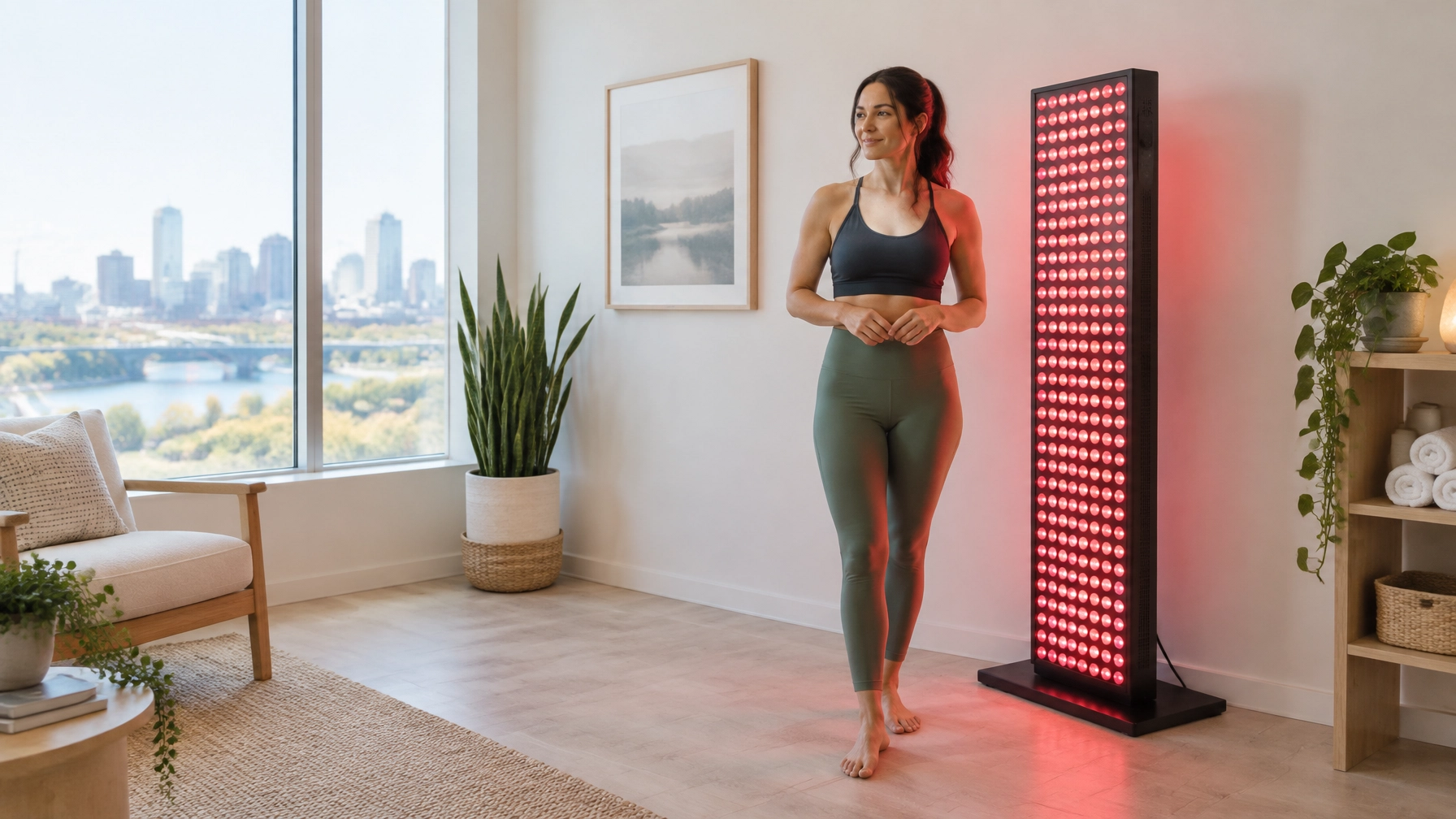
A high-quality at-home panel may support gradual improvements when it delivers suitable wavelengths and a clearly stated dose. However, small masks and wands usually treat only a limited area. Professional full-body systems can expose much more of the body evenly in a shorter session.
The main differences are not simply “home versus clinic.” They are:
- Dose: How much light reaches the skin or tissue
- Irradiance: The power delivered per square centimetre
- Coverage: How much of the body is treated at once
- Wavelength: The colour and depth of light
- Consistency: Whether the device delivers a predictable treatment each time
- Guidance: Whether someone can help screen for contraindications and choose an appropriate schedule
A professional session is not automatically better because it uses more power. Photobiomodulation follows a dose-response pattern. Too little light may not do much, but more is not always better. The goal is an appropriate dose for the treatment area and purpose.
How do masks, wands and professional panels compare?

At-home LED masks
LED masks are designed mainly for facial use. They may be convenient for mild skin concerns, but coverage is limited to the face and the fit may create uneven distance from the skin.
They can be a reasonable choice if you are prepared to:
- Follow the manufacturer’s instructions
- Use the device consistently
- Wear eye protection when advised
- Wait several weeks before judging results
- Avoid assuming that every mask has the same output
Some masks do not clearly list irradiance or energy density. Without those details, it is difficult to compare the device with clinical research.
Handheld wands
Wands can be useful for very small treatment areas. They are less practical for larger regions because you must move or reposition the device repeatedly.
For example, treating one small facial area may be manageable. Treating both knees, the back or the whole body can become time-consuming.
At-home panels
Larger home panels offer more coverage and may be better suited to people targeting a joint, muscle group or larger skin area. A quality panel that lists wavelength, irradiance and recommended distance can narrow the gap between home and professional treatment.
However, “high power” marketing does not prove effectiveness. Look for transparent specifications and clear instructions rather than promises of instant results.
Professional full-body systems
Professional panels offer practical advantages:
- More even exposure across a larger area
- Better positioning and consistent distance
- Shorter treatment time for full-body coverage
- Access to screening and basic treatment guidance
- A scheduled appointment that may make consistency easier
At Wave Therapy in Edmonton, full-body red and near-infrared sessions are used as a non-invasive wellness option for clients interested in skin, recovery, pain and body-contouring support. You can learn more about Wave Therapy’s approach.
Do home devices need to match clinical wavelengths and power?
They do not need to match a professional panel exactly.
They should, however, use wavelengths that are relevant to your goal and provide enough information to estimate the dose. The basic calculation is:
Dose = irradiance × time
For example, a lower-powered device may require a longer session to deliver a similar dose to a smaller area. A professional system may deliver that dose more quickly and across a much larger surface.
When comparing devices, ask:
- What wavelengths does it use?
- Is irradiance measured at the recommended treatment distance?
- How long should each session last?
- What area does it realistically cover?
- Is eye protection recommended?
- Is the device cleared or authorized for a specific use?
- Are the claims broader than the evidence?
A device marketed for wrinkle reduction should not automatically be assumed to treat chronic pain, hair loss or a serious medical condition.
Is red light therapy scientifically proven?
The fairest answer is that red light therapy has promising evidence for some uses, but it is not scientifically proven for every claim made online.
Research is strongest when the treatment, dose and condition are clearly defined. Results are less certain when people use different devices, different wavelengths and different schedules under the same general label of “red light therapy.”
Potential areas of support include:
- Skin rejuvenation
- Fine lines and wrinkles
- Skin texture and elasticity
- Mild acne-related inflammation
- Scar appearance
- Wound-healing support under appropriate care
- Hair growth in some cases of androgenetic alopecia
- Muscle recovery
- Joint discomfort and stiffness
- Some chronic pain conditions as an adjunct
- Knee osteoarthritis-related disability
- Appearance of cellulite and skin laxity
- Localized body-contouring support
- General wellness and recovery
The evidence is not equally strong for every item. For example, red light therapy should not be presented as a stand-alone weight-loss treatment. Body-contouring sessions may support changes in appearance or circumference for some people, but they are not a replacement for nutrition, movement or medical care.
Cleveland Clinic describes red light therapy as an emerging treatment with potential for several skin concerns, while emphasizing that more high-quality clinical trials are needed. It also notes that at-home devices may be less powerful than professional equipment and that results vary. Review Cleveland Clinic’s red light therapy guidance.
For a broader explanation, see Wave Therapy’s guide on whether red light therapy really works.
How many sessions are needed before results?
There is no single number for everyone.
Results depend on the condition, device, treatment area, starting point and frequency of use. A reasonable expectation is gradual change rather than an immediate transformation.
Many people begin by using red light therapy:
- Two to five times per week
- For approximately 10–20 minutes per treatment area
- For at least four to eight weeks before evaluating progress
Professional programs may involve several sessions over a few weeks. Wave Therapy commonly explains that visible changes may develop within approximately four to eight sessions, although individual results vary.
For home use, a lower-powered mask or wand may require more frequent sessions over a longer period. Do not extend sessions indefinitely in an attempt to accelerate results.
Wave Therapy also has a practical guide on whether you need red light therapy every day.
What does “red light therapy before and after” really show?
Before-and-after photos can be helpful, but they need context.
Lighting, camera angle, posture, hydration, skin products and time of day can all change how someone looks. A credible comparison should use:
- Similar lighting
- The same camera distance
- The same posture
- A consistent treatment period
- Clear information about the number of sessions
- Realistic expectations about what changed
Photos should be treated as one form of information: not proof that the same result will happen for everyone.
Can red light therapy treat serious conditions?
Red light therapy should not be used as a replacement for diagnosis or standard medical treatment.
Research is ongoing for conditions such as neurological disorders, depression, cancer-related symptoms and systemic disease. Some studies are promising, but many are small, use different protocols or do not provide enough long-term evidence.
Speak with your physician or specialist before using red light therapy if you have:
- Active cancer or a history of cancer treatment
- A photosensitive condition
- Medication that increases light sensitivity
- An eye condition
- A seizure disorder
- A serious chronic illness
- An unexplained wound, lump, rash or pain
- Pregnancy-related concerns
Professional red light therapy may be appropriate as a wellness or supportive treatment for some people, but it should not delay medical assessment.
Who is red light therapy for?
Red light therapy may be suitable for adults who want a non-invasive option to support:
- Skin rejuvenation
- Muscle recovery
- Mild joint discomfort
- General wellness
- Hair-growth support
- Localized body-contouring goals
- A regular recovery routine
It may not be suitable for everyone, especially without professional or medical guidance. Follow the device instructions, protect your eyes when advised and stop if you experience unusual irritation, pain or visual symptoms.
For clients combining light therapy with relaxation or recovery services, Wave Therapy can also connect you with Massage Quest, a provider and referral partner. Massage services are also available through the sister company Book a Therapy.
What is the practical answer for Edmonton clients?
If your goal is occasional facial care, a well-specified home mask may be convenient.
If your goal involves larger body areas, recovery, multiple joints or a structured routine, professional full-body sessions may be more practical. You are paying not only for the light, but also for coverage, consistency, convenience and guidance.
There is no need to choose based on hype. Start with your goal, review the device specifications and set a realistic timeline.
If you are exploring red light therapy in Edmonton, you can learn more about Wave Therapy sessions and availability. Explore the information, ask questions and book when you feel ready.
Leave a Reply