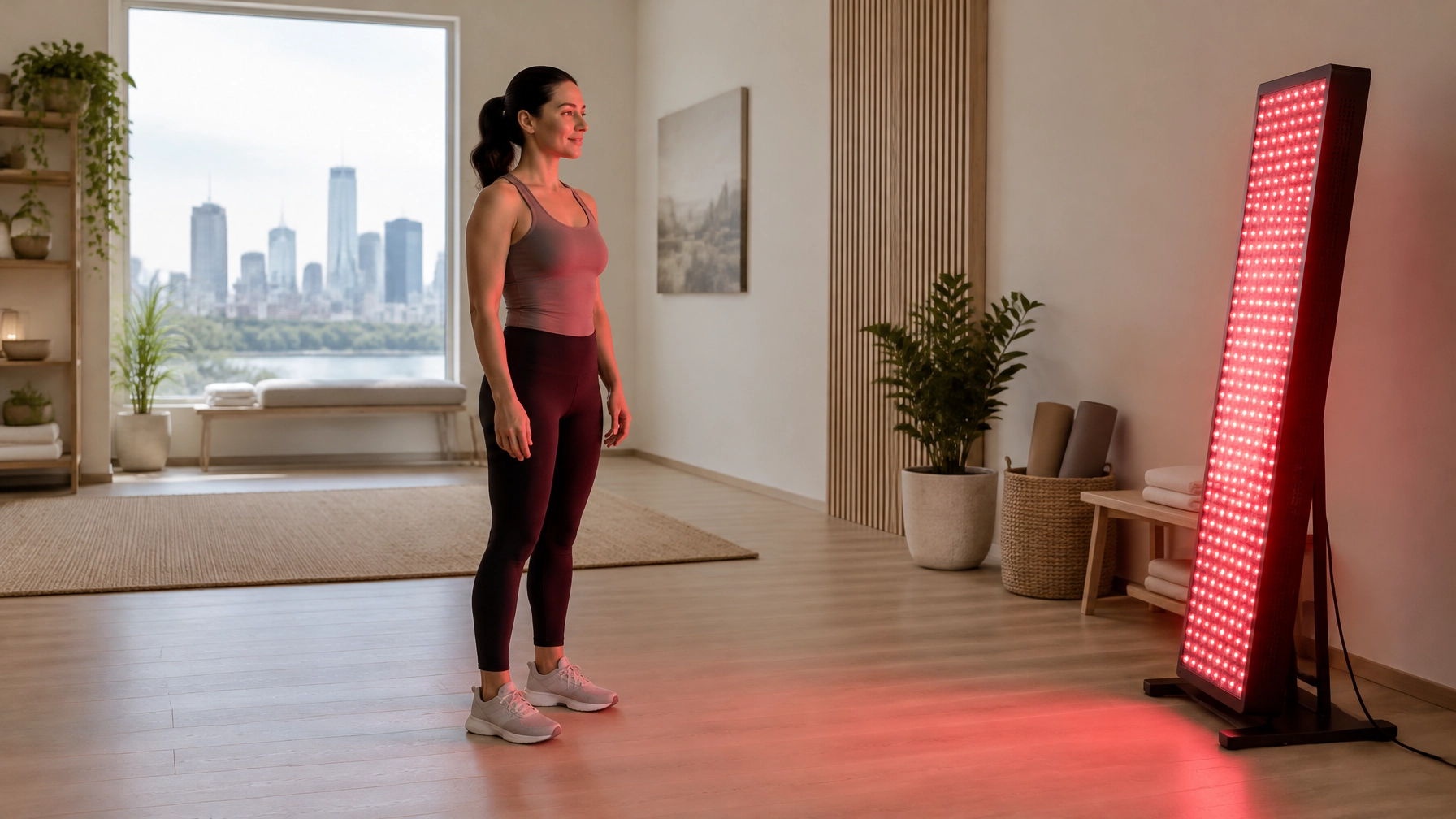
Red light therapy is often described as gentle, but that doesn’t mean more is always better. Like exercise, light therapy has a dose: the light’s intensity, how long you use it, and how often you repeat a session all matter.
Recent dermatology coverage and a new review of at-home LED facial devices have brought this “Goldilocks dose” question into focus. Here’s what the science says, and how to approach red light therapy sensibly in Edmonton.
Can you actually get too much red light therapy?
Yes. Photobiomodulation, the scientific term for red and near-infrared light therapy, can follow a biphasic dose response. In simple terms, too little light may not prompt a noticeable response, a suitable amount may stimulate cellular activity, and too much may reduce or blunt the effect.
This is sometimes described using the Arndt–Schulz curve. It’s a useful way to understand why longer or more frequent sessions don’t automatically produce better results. But it is not a precise dosing chart for every person or device. The exact “sweet spot” can depend on the treatment goal, wavelength, device output, distance and individual factors. A review of photobiomodulation parameters describes how differences in light settings can contribute to inconsistent results across studies.[1]
Think of it like exercise: a manageable workout can be productive, while too much training without enough recovery can leave you worse off. For light therapy, consistency and an appropriate dose matter more than chasing maximum exposure.
What counts as a “dose” of red light?
A light-therapy dose is not just a number of minutes. It depends on how much light reaches the skin, for how long, and at what distance.
- Irradiance, measured in milliwatts per square centimetre (mW/cm²), describes how much light power reaches a given area at a moment.
- Fluence, measured in joules per square centimetre (J/cm²), describes the total light energy delivered over a session.
- Time and distance influence the dose. A stronger output or closer position can deliver more light in the same amount of time.
A simple illustration: if a device delivers 20 mW/cm² at the skin for 10 minutes, the nominal fluence would be about 12 J/cm². That’s a calculation, not a recommendation. Actual delivery can differ, and settings from one device shouldn’t be used to set another device’s schedule.
Dermatology studies use a wide range of protocols. Roughly 4–18 J/cm² and 20–60 mW/cm² are useful context for understanding some reported skin-treatment ranges, not a universal target for every device or concern. The key is to follow the instructions for the specific device and its recommended distance.

What happens if you overdo it?
Many people tolerate red light therapy well when they use a device as directed. Still, overuse or misuse can lead to unwanted effects, including:
- Temporary redness, irritation or warmth
- Headache
- Eye strain or, in some circumstances, eye injury
- Changes in skin pigmentation
In a September 2026 safety discussion, Healio dermatology experts emphasized that adverse events are uncommon but may include headaches, eye effects and changes in pigmentation. They also stressed using the eye protection supplied with a device and avoiding excessive exposure.[2] The American Medical Association’s patient guidance also describes temporary redness or mild skin discomfort as possible side effects.
If your skin feels hot during treatment, or irritation continues after a session, stop and review the device instructions. Don’t try to make up for slow results by adding time or extra sessions. Protect your eyes as directed, and never look directly into the lights.
For more detail on precautions and possible red light therapy side effects, see Wave Therapy’s safety guide.
Is red light therapy safe for darker skin tones?
People with darker skin tones may be more sensitive to visible light, and overexposure can contribute to unwanted pigmentation changes. Healio experts have also noted that skin of colour may warm more quickly during treatment. The American Academy of Dermatology advises people with darker skin tones to discuss at-home red-light use with a dermatologist, particularly because dark spots can be more intense or long-lasting.
If you have a deeper skin tone, a history of melasma or post-inflammatory hyperpigmentation, or a current pigment concern, ask a dermatologist about whether a particular device is appropriate. If you and your clinician decide to try it, a conservative approach may include shorter exposures and a patch test, with careful attention to how your skin responds. A patch test cannot guarantee there will be no reaction.
A full-body panel is not a substitute for a dermatologist’s advice, especially for a skin condition or a concern about pigmentation.

Why don’t my at-home device results match the studies?
The name “red light therapy” covers devices with different wavelengths, output levels, treatment areas and instructions. A short session with one mask may not deliver the same dose as a longer session with a panel. Even two devices that advertise similar wavelengths may differ in how much light reaches the skin.
A systematic review published in Aesthetic Plastic Surgery on October 14, 2026, examined eight at-home facial LED studies involving 365 participants. The studies used different treatment schedules, and key measures such as irradiance and fluence were not consistently reported. The authors noted that more standardized research, including studies with a wider range of skin phenotypes, is needed.[3]
The review found that at-home devices appeared promising for some facial-aging measures, with adverse events generally infrequent and mild. But it does not establish one ideal dose, prove that all consumer devices match research equipment, or show that more use improves results. Device quality and measured output matter; in an October 2026 prescribing discussion, Healio dermatologist David Ozog advised checking whether a device’s power and irradiance have been evaluated.[4]
What can properly dosed red light therapy help with?
Evidence varies by purpose, device and treatment protocol. Red light therapy is best considered an adjunct, not a guaranteed treatment or a replacement for medical care. It may support:
- Fine lines and wrinkles as part of facial skin rejuvenation
- Skin texture and tone
- Collagen-related skin support
- Some types of hair loss, particularly pattern hair loss, though results vary
- Muscle recovery as a complement to training and rest
- Joint or muscle discomfort, depending on the target, device and protocol
- Inflammation-related symptoms in some settings
- Wound-healing support when used for an appropriate purpose and under suitable guidance
- Cellulite appearance and skin tightening as cosmetic goals, with results varying
- Fat reduction support as an adjunct to healthy routines, not a substitute for nutrition, movement or medical advice
The AMA’s patient overview cautions that claims should be matched to the evidence and treatment target. For example, evidence for facial skin is not proof that a home mask will relieve deeper joint inflammation.
What is a sensible way to start?
For many at-home devices, about 10 minutes every other day is a cautious starting point: provided that schedule fits the manufacturer’s instructions. It is not a universal prescription; treatment recommendations vary with the device and purpose. If the device specifies a shorter session or a different distance, follow its directions instead.
A few practical habits can help keep sessions consistent and sensible:
- Use the manufacturer’s recommended distance and session time.
- Don’t extend a session or add treatments to compensate for missed days.
- Wear the recommended eye protection.
- Stop and seek advice if you develop persistent irritation, pain or new pigmentation.
- Check with a health professional before use if you have a photosensitive condition, take medication that increases light sensitivity, or have a skin or eye concern.

Red light therapy should sit alongside, not replace, sleep, nutrition, exercise and appropriate medical care. At Wave Therapy, an Edmonton provider of full-body red and near-infrared light sessions, treatment settings are selected for the session rather than assuming that one dose fits everyone. If you’re exploring how often to use red light therapy, remember that a steady routine is usually more sensible than increasing intensity.
For a broader wellness routine, some clients also explore massage through our local partners, Massage Quest and Book a Therapy.
The practical takeaway: start conservatively, follow the device guidance and give a routine time to work. If you’re considering red light therapy in Edmonton, you can learn more about Wave Therapy and explore sessions when you’re ready.
Leave a Reply