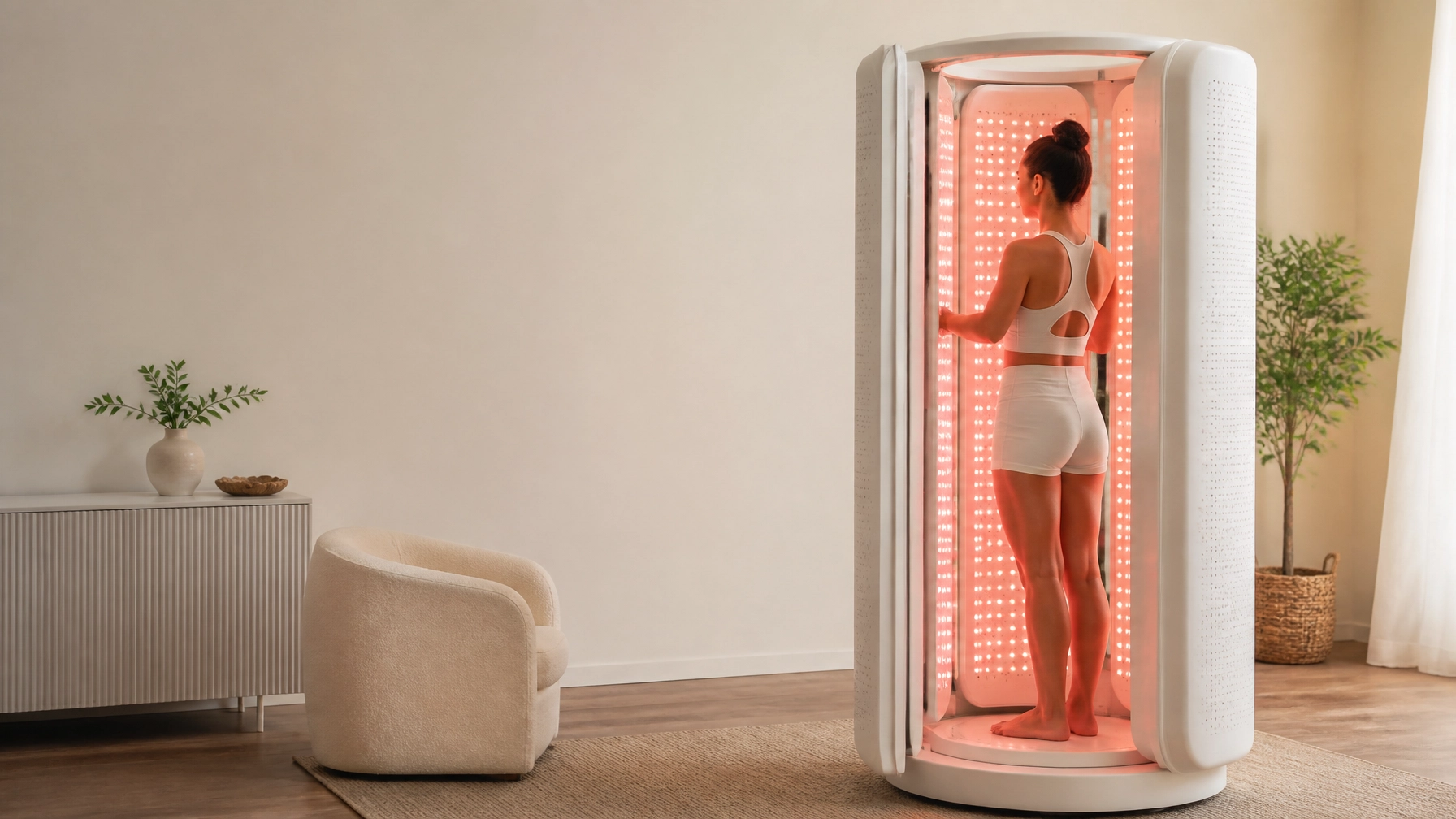
If you are searching for answers about red light therapy, belly fat, love handles, or body contouring, you are not alone. Many Edmonton residents want a non-invasive option to support their wellness goals without surgery or significant downtime.
The honest answer is that red light therapy may support modest, localized changes in body measurements. It is not a replacement for nutrition, movement, sleep, or medical weight-management care.
So, does red light therapy work for fat loss? Current research suggests it may help with circumference reduction in certain areas. However, the results are usually measurable but modest, and they vary from person to person.
Can red light therapy reduce belly fat or love handles?
Red light therapy may help reduce the appearance or circumference of subcutaneous fat in areas such as:
- The waist and abdomen
- The hips and love handles
- The thighs
- The upper arms
- Areas affected by cellulite or loose-looking skin
It is important to understand the difference between body contouring and weight loss.
Body contouring focuses on localized shape and measurements. Traditional weight loss involves reducing overall body mass, including fat throughout the body. Red light therapy is better understood as a supportive body-contouring treatment, not a way to lose a large amount of weight.
It also cannot selectively remove visceral fat: the deeper fat stored around the organs. Waist circumference can be influenced by several factors, including subcutaneous fat, muscle, posture, bloating, and measurement technique.
How does red and near-infrared light work at the cellular level?
Red light therapy is also called photobiomodulation, or PBM. It uses low-level red and near-infrared wavelengths to influence cellular activity without surgical incisions or the intense heat associated with tissue ablation.
At a basic level, the light is absorbed by structures within cells, including mitochondria. Mitochondria are often described as the cell’s energy-producing systems. Light exposure may influence mitochondrial signalling, energy production, blood flow, and inflammatory pathways.
For fat reduction, researchers have proposed several possible mechanisms:
- Adipocyte signalling: Red and near-infrared light may influence the behaviour of fat cells, or adipocytes.
- Lipolysis: Lipolysis is the process of breaking down stored triglycerides into fatty acids and glycerol.
- Cell membrane changes: Some studies suggest that low-level light may temporarily affect the adipocyte membrane, allowing stored lipids to move out of the cell.
- Tissue remodelling: Light may also support circulation, collagen activity, and changes in the appearance of the skin overlying the treated area.
The exact mechanism is still being studied. A review published in Lasers in Surgery and Medicine describes lipolysis and temporary changes in adipocytes as proposed explanations, while also noting that more research is needed to confirm how these effects occur in living humans.
This is why it is more accurate to say that red light therapy may support localized fat-cell and tissue changes: not that it “melts fat” or permanently destroys fat cells.

What does clinical research say about waist and hip circumference?
Some clinical studies have reported small reductions in waist, hip, thigh, or arm circumference after a series of low-level light treatments.
A randomized pilot study indexed by PubMed followed 60 adults with overweight across three treatment schedules. The group receiving treatments twice weekly for six weeks had an average:
- Weight reduction of approximately 1 kilogram
- Waist reduction of about 2 inches by week six
- Body-fat mass reduction of approximately 1.1 kilograms
The study is useful, but it was a pilot study, and its sample size was small. Results should not be interpreted as a guarantee for every client.
A separate randomized, controlled study reviewed in PMC reported an average combined reduction of about 3.5 inches across the waist, hips, and thighs after six treatments over two weeks. Combined circumference measurements do not mean that 3.5 inches came from one area. They also do not equal 3.5 inches of fat loss.
Other studies have reported reductions in abdominal, hip, thigh, and upper-arm measurements. However, some were observational, had no sham-treatment group, or had limited follow-up. That makes it difficult to separate the effect of the light from factors such as hydration, activity, diet, measurement variation, or natural changes over time.
As Healthline explains, the evidence points toward modest results, while larger and longer-term studies are still needed.
Does red light therapy boost resting metabolism?
This is a common question, especially in searches for “red light therapy metabolism.”
At this time, clinical body-contouring research does not show strong evidence that red light therapy produces a meaningful, lasting increase in resting metabolic rate.
Some studies discuss mitochondrial activity or metabolic signalling at the cellular level. That does not automatically mean the body burns significantly more calories at rest. A true resting metabolic rate increase would need to be measured directly using methods such as indirect calorimetry.
Most red light therapy body-contouring trials focus on:
- Waist, hip, thigh, or arm circumference
- Body weight
- Body-fat measurements
- Ultrasound measurements of fat thickness
- Skin appearance and satisfaction
They generally do not demonstrate a clinically significant resting metabolism boost.
The practical takeaway is simple: red light therapy may support localized contouring, but it should not be marketed as a metabolism-raising shortcut.
What are the realistic red light therapy benefits?
Potential benefits may include:
- Small, measurable changes in waist, hip, or thigh circumference
- Support for the appearance of body contours
- Possible improvement in the look of cellulite
- Support for collagen production and skin firmness
- A comfortable, non-invasive treatment experience
- No surgical incisions or typical recovery period
Results are usually more realistic when red light therapy is combined with consistent habits, including:
- A balanced eating pattern
- Regular walking, resistance training, or other enjoyable movement
- Adequate sleep
- Hydration
- A manageable long-term routine
Red light therapy before and after photos can be helpful, but they should be taken carefully. Use the same lighting, clothing, posture, camera angle, and time of day. A measuring tape and progress notes can provide a more useful comparison than photographs alone.
At Wave Therapy, many clients are told to expect visible changes within approximately four to eight sessions, although individual results can vary. A treatment series may be recommended rather than a single appointment because the research generally evaluates repeated sessions.

Who may be a good candidate?
Red light therapy may be appropriate for adults who:
- Want a non-invasive approach to localized body contouring
- Have realistic expectations about small or gradual changes
- Are generally healthy and able to participate in a wellness program
- Understand that treatment works best alongside nutrition and exercise
- Prefer a comfortable option with little or no downtime
It may be especially appealing to people who are near their preferred weight but have areas of concern such as the waist, hips, thighs, or arms.
Some people also explore light-based wellness support for other goals, such as red light therapy for muscle recovery, when building a broader recovery and wellness routine.
Who should avoid treatment or ask a healthcare professional first?
Red light therapy is not appropriate for everyone. Speak with a healthcare professional before treatment if you:
- Are pregnant or breastfeeding
- Have active cancer or a suspicious lesion in the treatment area
- Have a photosensitive condition
- Take medication that increases sensitivity to light
- Have a significant eye condition or recently had eye surgery
- Have recently had surgery or have an active infection, burn, or open wound
- Have a medical condition that requires ongoing care
Use eye protection when recommended, and follow the provider’s instructions about treatment time, distance, and frequency. The Cleveland Clinic notes that red light therapy appears to be safe when used short-term and as directed, but misuse can affect the skin or eyes.
It is also important to distinguish between an FDA-cleared device for a specific use and an FDA-approved treatment for general weight loss. Red light therapy should not be presented as a substitute for medical weight-management care.
What does a Wave Therapy full-body session look like?
A full-body session at Wave Therapy is designed to be straightforward and comfortable.
A typical visit may include:
- A short intake: The provider reviews your goals, health history, medications, and any safety considerations.
- Positioning in the light therapy system: The system exposes larger areas of the body to red and near-infrared light.
- A comfortable treatment period: Most clients experience gentle warmth rather than pain. A session may take roughly 30–45 minutes, depending on the plan.
- Immediate return to your day: There is generally no surgical recovery period, so many people return to normal activities after treatment.
- Progress tracking: Measurements, photos, or personal goals may be reviewed over a series of visits.
You can learn more about Wave Therapy’s Edmonton sessions or view the current Edmonton booking page.
Some clients also pair light-based wellness treatments with other supportive services. For massage and recovery-focused care, you can explore Massage Quest or Wave Therapy’s sister company, Book a Therapy.
The bottom line: Does red light therapy work?
Red light therapy may help support modest, localized changes in waist, hip, thigh, or abdominal measurements. Research is encouraging but not conclusive, and results are not the same as dramatic weight loss.
The most accurate expectations are:
- It may support body contouring rather than major weight loss.
- Changes are usually small and may require multiple sessions.
- It works best alongside diet, exercise, sleep, and other healthy habits.
- It has not been shown to meaningfully raise resting metabolic rate.
- Long-term durability and the ideal treatment protocol still need more research.
If you are researching red light therapy Edmonton options, consider asking about the technology used, treatment frequency, safety screening, progress tracking, and what results are realistic for your goals.
If you would like to keep learning, you can learn more about Wave Therapy or explore sessions and booking options at your own pace.
Health note: This article is for general education only. It does not replace medical advice or prescribed weight-management care.
Leave a Reply