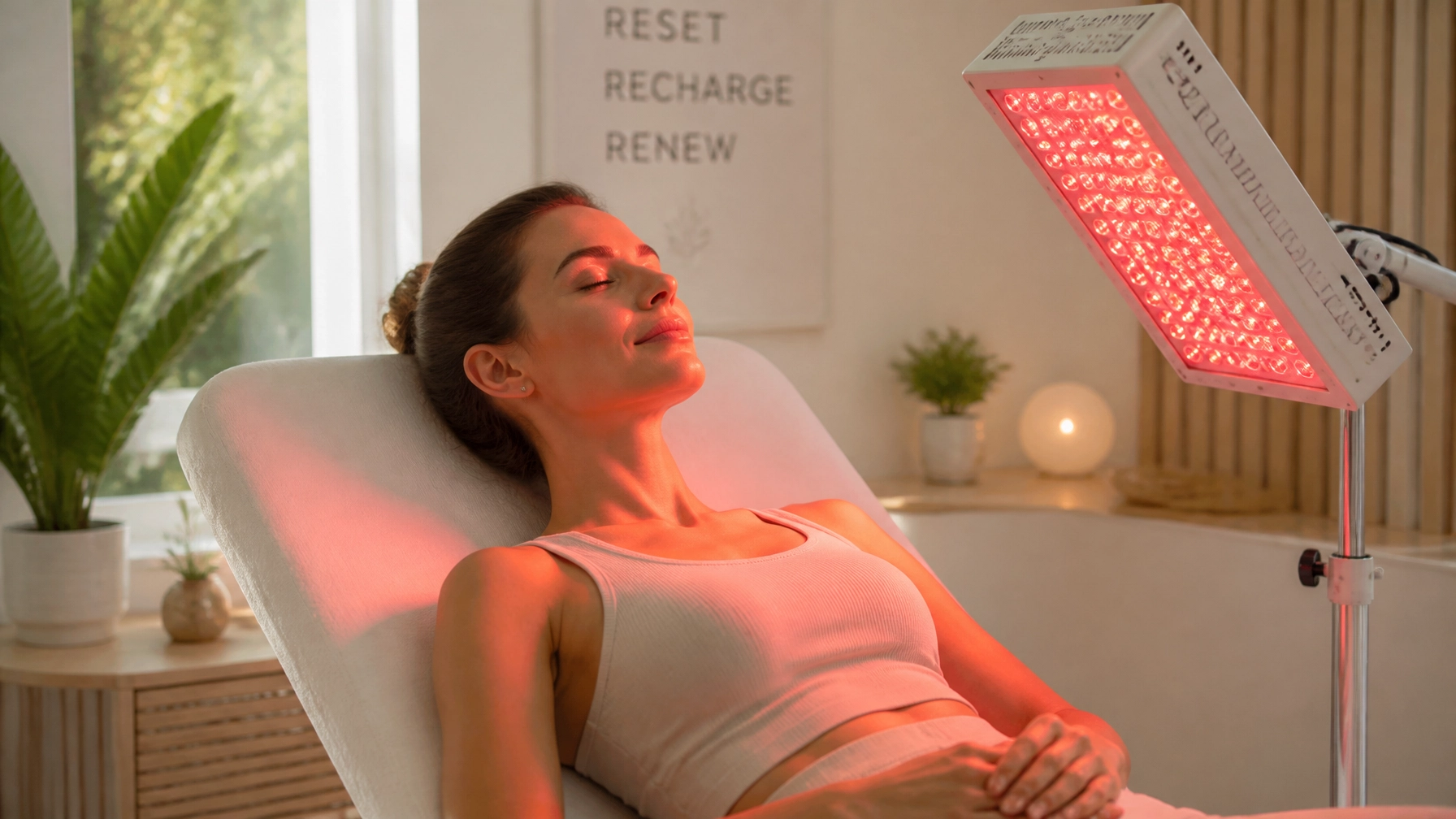
If you are searching for red light therapy before and after photos, you may also be wondering what those results actually mean.
How soon should you notice a difference? Will pain improve before skin does? Can red light therapy reduce body fat? And how many sessions are usually needed?
The honest answer is that results depend on your goal, starting point, treatment plan, and consistency. Red light therapy is not an overnight transformation. It uses red and near-infrared wavelengths to support natural cellular processes, so changes tend to build over time.
For many people, four to eight consistent sessions is a reasonable point to review early progress. That is not a guarantee of dramatic results. It is simply a practical checkpoint for noticing changes in comfort, recovery, skin appearance, or overall wellness.
What happens during red light therapy?
Red light therapy is also called photobiomodulation. It uses low-level red and near-infrared light, commonly in the approximate 600–850 nanometre range.
In simple terms, light energy is absorbed by cells and may support mitochondrial activity, circulation, inflammation regulation, and tissue repair. Red light is generally used for more superficial goals such as skin support. Near-infrared light can reach deeper tissues and is often included in protocols for muscles and joints.
According to the Cleveland Clinic’s overview of red light therapy, the treatment is promising for some applications, but research quality and outcomes vary by condition and device.
That is why a responsible before-and-after comparison should consider more than a single photograph.
Why before-and-after photos can be misleading
Photos can help show progress, but they are not perfect proof. Changes in lighting, camera angle, posture, hydration, skin products, and even the time of day can make results appear larger or smaller.
For a more useful comparison:
- Take photos in the same location and lighting.
- Use the same camera distance and angle.
- Keep your posture consistent.
- Measure body-contouring areas in the same way each time.
- Track symptoms such as stiffness, soreness, or mobility in a journal.
- Compare progress after a full treatment period, not after one or two visits.
Your personal experience may also improve before a visible change appears. For example, a person may notice less morning stiffness before any difference is visible in a photograph.
Red light therapy before and after for pain and inflammation
Pain and joint comfort are common reasons Edmonton clients explore red light therapy, particularly during periods of stiffness, physical activity, or persistent soreness.
Some people notice gentle warmth or temporary relaxation during their first session. Mild muscle soreness may feel better after a few sessions. Chronic joint concerns usually require more patience.
A realistic general timeline may look like this:
- Sessions 1–3: Possible temporary comfort, warmth, or relaxation.
- Sessions 4–8: Some people begin noticing more consistent changes in stiffness or everyday movement.
- Weeks 4–8 and beyond: Longer-standing pain may require an ongoing plan and additional support such as exercise, physiotherapy, or massage.
The research is encouraging but not conclusive for every pain condition. A 2024 systematic review and meta-analysis on photobiomodulation for knee osteoarthritis found reduced pain intensity, but rated the certainty of evidence as very low. The authors concluded that photobiomodulation may be useful as a complement to standard care rather than as a stand-alone treatment.

Red light therapy should not delay medical assessment if pain is severe, unexplained, worsening, or associated with significant swelling, weakness, numbness, or injury.
Red light therapy before and after for skin rejuvenation
Skin-related results often take longer than people expect. A subtle glow or refreshed appearance may be noticed within the first few weeks, but collagen-related changes require repeated treatment and natural skin remodeling.
A general timeline is:
- Sessions 1–4: Skin may feel calm, comfortable, or refreshed. Any visible glow is likely to be subtle.
- Sessions 4–8: Tone and texture may begin to look more even for some people.
- Weeks 8–12: Fine lines, firmness, and overall texture are more appropriate to evaluate.
- Three months and beyond: Continued improvement may occur with maintenance, although results can vary.
A randomized controlled trial indexed on PubMed examined red light and near-infrared treatments for photoaged skin. After 30 treatments over approximately 15 weeks, researchers reported improvements in wrinkles, skin roughness, and intradermal collagen density.
This does not mean every client will see the same percentage change. Professional studies use specific devices, doses, schedules, and outcome measurements. A home mask or different clinic system may not produce identical results.
For more detail, read Wave Therapy’s guide to red light therapy for skin rejuvenation and anti-aging.
Red light therapy before and after for muscle recovery
Muscle recovery often follows a faster timeline than skin rejuvenation because it is usually assessed around exercise sessions.
Fitness enthusiasts may use red and near-infrared therapy before or after strength training, running, sports, or physically demanding work. Some people report less next-day soreness after a few sessions, while others need several weeks before noticing a reliable difference.
Possible expectations include:
- After one session: A comfortable, relaxing experience and possible temporary relief from tightness.
- Within 24–96 hours after exercise: Potentially less soreness or improved recovery, depending on the workout and protocol.
- After 2–4 weeks: More consistent recovery may become easier to notice if sessions are regular.
- Over a training block: The main benefit may be maintaining training consistency rather than creating a dramatic visual transformation.
A systematic review and meta-analysis by Vanin and colleagues found potential improvements in muscular performance and exercise-related fatigue. However, the studies used different treatment parameters, and evidence quality ranged from very low to moderate.
Red light therapy and massage also serve different purposes. Light therapy may support cellular recovery and inflammation regulation, while massage can address soft-tissue tension and relaxation. Edmonton clients interested in bodywork can explore Massage Quest or therapeutic massage through Wave Therapy’s sister company, Book a Therapy.
Red light therapy before and after for fat loss and body contouring
This is the area where realistic expectations matter most.
Some low-level light and body-contouring protocols report modest localized changes in circumference or skin appearance. However, that is different from proven whole-body fat loss or meaningful weight reduction.
The Cleveland Clinic notes that there is not enough scientific evidence to support red light therapy as a weight-loss or cellulite-removal solution.
For body-contouring goals:
- A few sessions are generally too early to judge results.
- Some protocols evaluate progress after approximately 8–12 sessions.
- Measurements should be taken consistently.
- Nutrition, movement, sleep, fluid balance, and other factors can influence results.
- Red light therapy should not replace exercise, nutrition support, or medical weight-management care.
The most responsible description is non-invasive body-contouring support, not guaranteed fat loss. Wave Therapy clients can explore Edmonton session options and ask which goals and protocols are appropriate for them.
Who is red light therapy for?
Red light therapy may be suitable for health-conscious adults who want a non-invasive wellness option for:
- Mild joint stiffness or everyday muscle discomfort.
- Post-workout recovery support.
- Skin tone, texture, and collagen support.
- Non-invasive rejuvenation.
- General relaxation and wellness.
- Complementary support alongside an established care plan.
It is not the right choice for every person or every condition. Speak with a healthcare professional before treatment if you:
- Have a photosensitive condition such as lupus or porphyria.
- Take medication that may increase sensitivity to light.
- Have active cancer or a suspicious lesion in the treatment area.
- Are pregnant or considering full-body treatment during pregnancy.
- Have a seizure disorder triggered by flashing or pulsed light.
- Have a significant eye condition or recent eye surgery.
- Have an active infection, severe rash, or an unexplained wound.
Wave Therapy’s related guide explains eye protection during red light therapy and why device power, distance, and wavelength matter.
What should you expect at a Wave Therapy session?
A typical session begins with a discussion of your goals and relevant health considerations. You are then positioned near the red and near-infrared light system according to the treatment plan.
Most sessions are comfortable. You may notice gentle warmth, but there are no needles, incisions, or expected recovery period. Eye protection may be recommended or provided, particularly when the face or scalp is exposed to bright, high-output light.
Session length and frequency depend on the system and your goal. Rather than adding extra time on your own, follow the provider’s schedule. More light is not automatically better.
The practical takeaway
The most realistic red light therapy before and after timeline in 2026 looks like this:
| Goal | Possible early changes | More meaningful review period |
|---|---|---|
| Pain and inflammation | A few sessions to several weeks | Approximately 4–8 weeks or longer |
| Skin rejuvenation | Subtle glow within several weeks | About 8–12 weeks |
| Muscle recovery | Within 24–96 hours around exercise | Approximately 2–4 weeks of regular use |
| Body contouring | Usually gradual and difficult to predict | Often assessed after 8–12 sessions |
| Hair support | Usually no immediate visible change | Several months, when appropriate |
The best results are measured honestly, over a realistic period, and in the context of your overall health.
You can learn more about Wave Therapy or explore available sessions when you feel ready.
Sources and further reading
- Cleveland Clinic: Red Light Therapy
- Photobiomodulation for knee osteoarthritis pain and disability : PubMed
- Controlled trial of red and near-infrared light for photoaged skin : PubMed
- Photobiomodulation for muscular performance and fatigue : PubMed
- Wave Therapy Blog: How Long Does It Take to See Red Light Therapy Results?
Leave a Reply