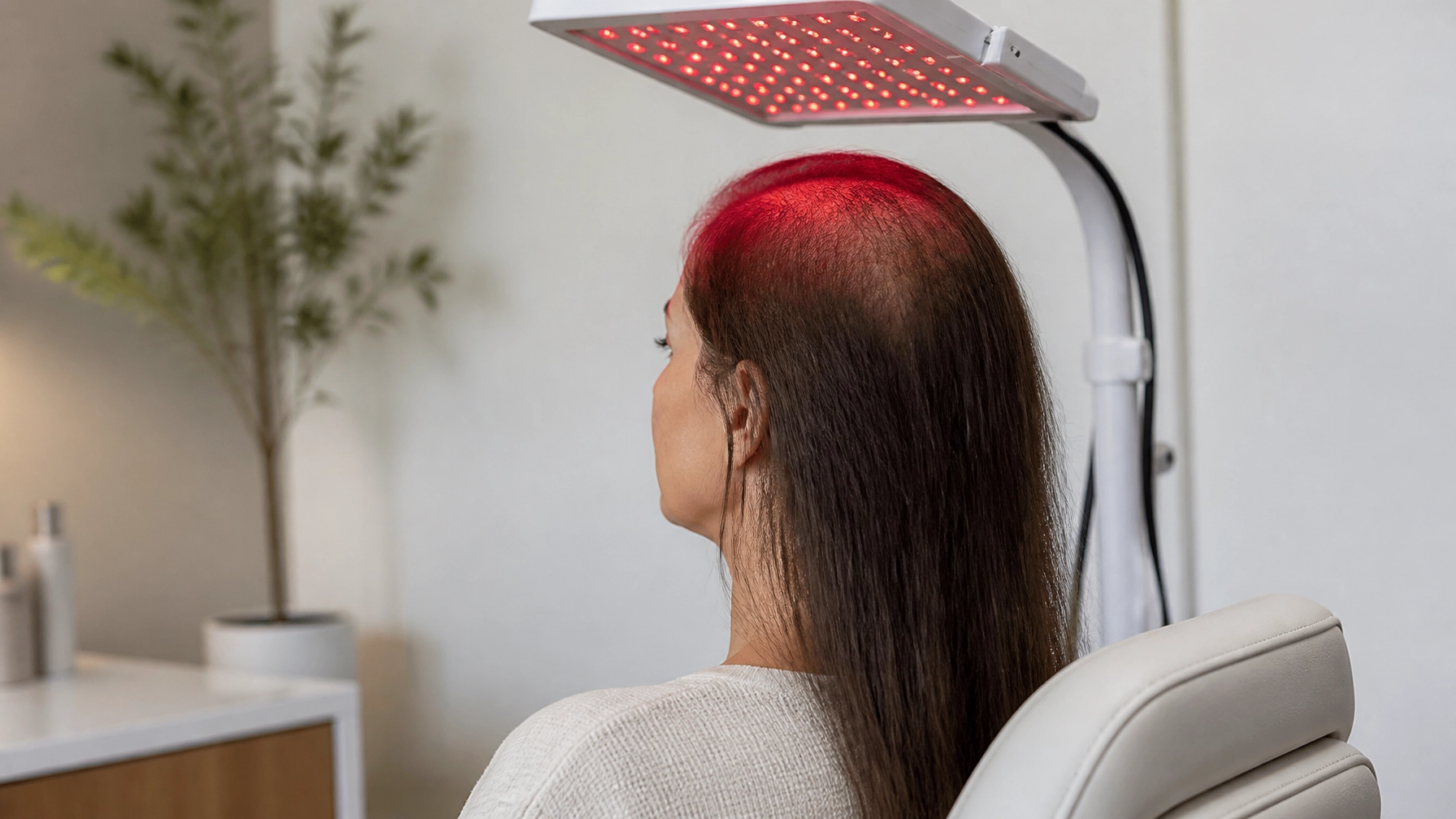
Hair loss is common, but that does not make it easy to manage. If you have noticed more hair in the shower, a widening part, or gradual thinning at the temples, you may be wondering whether red light therapy can actually help.
The short answer is yes, red light therapy can support hair growth in some people: especially those with early-to-moderate pattern hair loss. However, it is not a miracle cure, and results depend on the cause of hair loss, the device used, and consistency over time.
Here is what the research says in 2026.
What is red light therapy for hair growth?
Red light therapy is also called photobiomodulation or low-level light therapy (LLLT). It uses low-intensity red light, often in the 630–680 nanometre range, to stimulate biological activity in cells.
For hair, the goal is to support the function of follicles that are still active but becoming smaller or less productive.
In simple terms, red light may:
- Support cellular energy production in hair follicle cells
- Help follicles remain in the active growth phase for longer
- Encourage thicker hair shafts
- Improve hair density over time
- Reduce some of the inflammation that may affect follicle function
A laboratory study of human hair follicles found that 650-nanometre red light promoted follicle growth and delayed the transition from the growth phase to the regression phase. This is useful mechanistic evidence, although laboratory findings do not always translate directly to visible results in people. (Yang et al., PubMed PMID 34858007)

What does the clinical research show?
The strongest evidence is for androgenetic alopecia, also known as male or female pattern hair loss.
A 2024 systematic review and meta-analysis examined 38 studies involving 3,098 patients. Most participants had androgenetic alopecia. Compared with placebo or sham treatment, low-level light therapy produced a significant increase in hair density after treatment periods ranging from 4 to 26 weeks. The researchers described LLLT as a promising option for androgenetic alopecia, while noting that more research is needed for other types of hair loss. (PubMed PMID 39404126)
Another systematic review and meta-analysis included 36 studies and 966 patients. It found that red and infrared photobiomodulation were more effective than control treatments for androgenetic alopecia. (PubMed PMID 35510860)
These findings are encouraging because they include controlled clinical trials rather than relying only on personal testimonials. At the same time, the studies used different devices, wavelengths, treatment schedules, and methods of measuring hair growth. That makes it difficult to predict an exact result for every person.
The most accurate conclusion is:
Red light therapy can produce a real but usually moderate improvement in hair density for some people with pattern hair loss.
It is better viewed as a treatment option or adjunct: not a guaranteed replacement for medical hair-loss care.
How does red light therapy compare with 5% minoxidil?
This is one of the most practical questions people ask.
A randomized controlled trial compared low-level light therapy with topical 5% minoxidil in men with androgenetic alopecia. Participants used either:
- 5% topical minoxidil twice daily, or
- LLLT at approximately 633 nanometres, three times per week for 10 minutes
After six months, both groups had significant improvements in hair density compared with baseline. The study found no significant difference between the two groups, suggesting that LLLT produced results comparable to 5% minoxidil in that particular trial. (PubMed PMID 40697690)
That does not prove red light therapy is always equal to minoxidil. It was one study, and the results may not apply to every device or every type of hair loss. Minoxidil also has a longer history of clinical use.
There is also some evidence for combining the two. A published review of the literature on low-level light therapy combined with minoxidil concluded that combination therapy appears at least equivalent to, and in some trials superior to, minoxidil monotherapy for improving hair-growth outcomes. As with any review, the underlying studies varied in quality, devices, and treatment protocols, so it is best viewed as supportive rather than definitive evidence. (PubMed PMID 36937156)
If you are considering minoxidil, finasteride, or another medical treatment, discuss the options with a physician or dermatologist. Red light therapy may fit into a broader plan, but it should not delay diagnosis or evidence-based treatment.
Who is red light therapy most likely to help?
Red light therapy may be worth discussing if you have:
- Early or moderate male pattern hair loss
- Early or moderate female pattern hair loss
- Gradual thinning at the crown, hairline, or part
- Follicles that are still producing fine or miniaturized hairs
- A preference for a non-invasive, drug-free or drug-sparing option
- The patience to follow a regular treatment schedule
It may be especially useful for people who want to support existing follicles rather than pursue a surgical procedure.
However, the earlier the cause of progressive thinning is identified, the more options you may have. A dermatologist can assess your scalp and determine whether pattern hair loss is the likely explanation.
Who should not rely on red light therapy alone?
Red light therapy is not appropriate as a stand-alone answer for every type of hair shedding.
You should seek medical assessment before starting treatment if you have:
- Sudden or rapid hair loss
- Round or sharply defined bald patches
- Scalp pain, scaling, crusting, or signs of infection
- Significant itching or inflammation
- Hair loss after illness, major stress, rapid weight change, or childbirth
- Suspected nutritional, hormonal, thyroid, or medication-related hair loss
- Scarring or shiny areas where follicles may no longer be present
Research on LLLT is strongest for androgenetic alopecia. Evidence is much less established for conditions such as alopecia areata, telogen effluvium, and scarring alopecia.
Red light cannot recreate a follicle that has been permanently destroyed. It also cannot correct an untreated medical cause of shedding.

What should you expect from hair-growth sessions?
Hair grows slowly, so consistency matters more than a single long session.
Clinical studies commonly use schedules such as:
- Two to three sessions per week
- Approximately 10 to 20 minutes per session
- A treatment period of at least 16 to 24 weeks
Some people notice changes in shedding or hair texture first. Visible improvements in density usually take several months because follicles move through a natural growth cycle.
During a professional session, you can generally expect:
- A brief discussion of your goals and relevant health history
- Positioning under a red light or red and near-infrared system
- Gentle warmth or a relaxing sensation
- No needles, incisions, or recovery period
- A recommendation to follow a consistent schedule
At Wave Therapy, clients in Edmonton use advanced red and near-infrared light systems for non-invasive wellness treatments. Because hair-growth trials often use targeted scalp devices, it is reasonable to ask which system and protocol are appropriate for your specific goal rather than assuming every full-body system has been studied for hair loss.
You can also review Wave Therapy’s Edmonton session options or browse the Wave Therapy Blog for related safety and wellness information.
Is red light therapy safe for hair loss?
Overall, clinical studies report that LLLT is well tolerated. Some people may experience temporary warmth, mild redness, tingling, scalp sensitivity, or a headache. These effects are generally mild, but you should stop and seek advice if you experience a significant or persistent reaction.
Speak with a healthcare professional before treatment if you:
- Have a photosensitive condition
- Take medication that increases light sensitivity
- Have an active scalp condition
- Are receiving treatment for cancer
- Have concerns about eye exposure during scalp or facial treatments
A reputable provider should explain the device, treatment schedule, and eye-safety procedures before your session.
Can massage help with hair growth too?
Massage does not replace hair-loss treatment, and it has not been shown to regrow hair in the same way that LLLT is studied for pattern hair loss.
However, massage can be part of a broader wellness routine by supporting relaxation, body awareness, and recovery. If stress or muscle tension is affecting your general well-being, Wave Therapy clients can explore provider and referral options through MassageQuest or therapeutic massage bookings through sister company Book a Therapy.
The goal is not to promise that one treatment solves everything. It is to choose supportive services that match your actual needs.
The bottom line
So, does red light therapy really grow hair?
For some people with androgenetic alopecia, the 2026 evidence says yes. Systematic reviews and controlled trials show improvements in hair density compared with sham treatment. One recent randomized trial found results comparable to 5% minoxidil, and a review of the literature suggests combining LLLT with minoxidil may offer benefits at least equivalent to, and in some trials greater than, minoxidil alone.
The realistic expectations are just as important:
- Results are gradual, not immediate
- Consistency is essential
- It works best when follicles are still active
- It is not proven for every cause of hair loss
- A medical assessment may be necessary before treatment
- It may work best as part of a larger hair-care plan
If you are curious about whether red light therapy fits your goals, you can learn more about Wave Therapy’s Edmonton treatments and book when you feel ready.
Scientific references
- Low-level laser/LED therapy for alopecia: systematic review and meta-analysis, PubMed PMID 39404126
- Photobiomodulation for hair loss: systematic review and meta-analysis, PubMed PMID 35510860
- Low-level light therapy versus topical 5% minoxidil, PubMed PMID 40697690
- Low-level light therapy combined with minoxidil: review of the literature, PubMed PMID 36937156
Leave a Reply