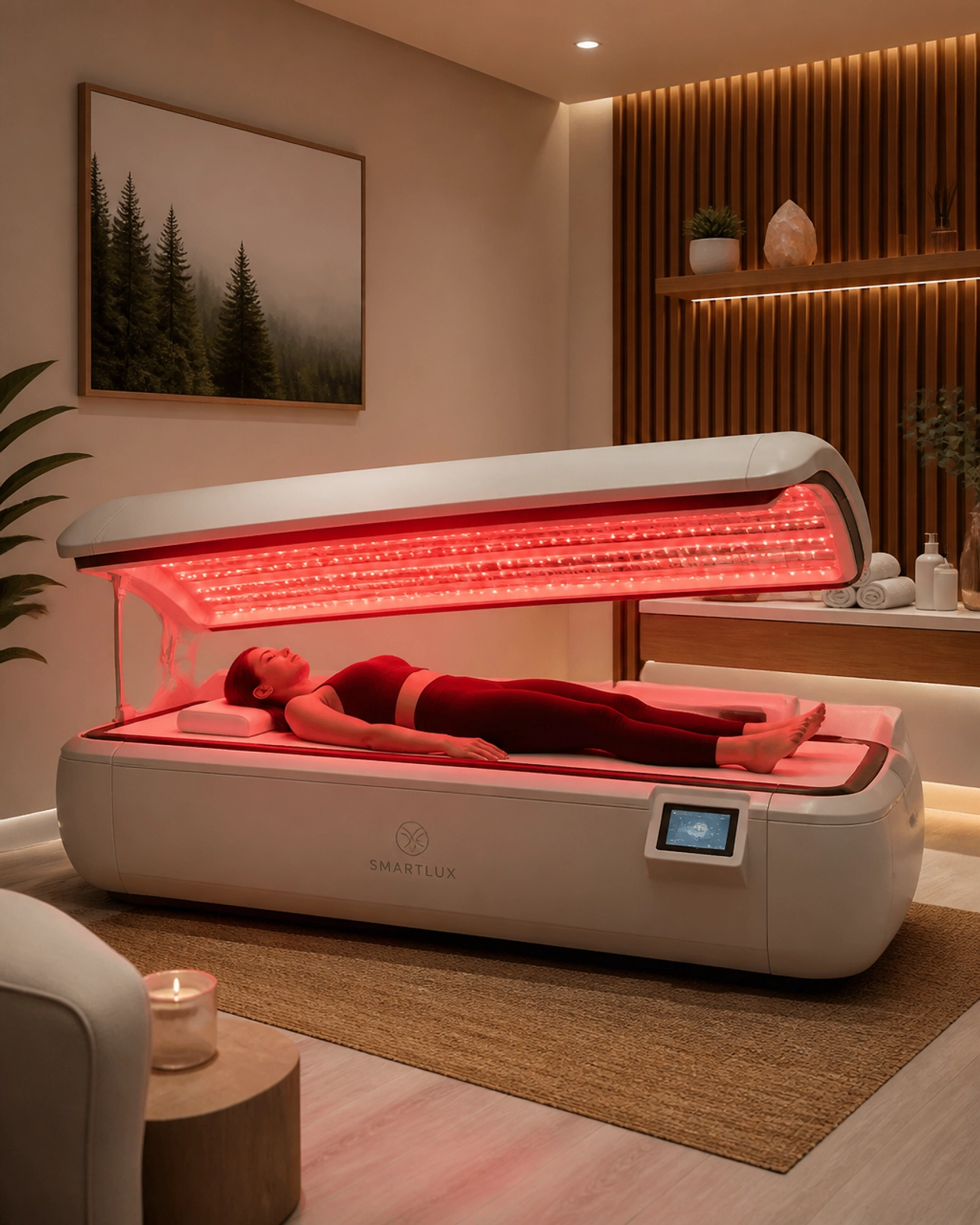
If you are comparing red light therapy devices in 2026, you have probably noticed that the choices are expanding quickly. There are masks, handheld wands, small panels, full-body systems, and products marketed with increasingly impressive claims.
But the most expensive device is not automatically the best one. The brightest device is not necessarily the most effective either.
When choosing a red light therapy device, focus on the specifications that affect the actual dose delivered to your body. Wavelength, irradiance, coverage, treatment time, safety features, and consistency matter more than brand hype or the number of LEDs listed on a product page.
This guide explains what to look for, whether home or professional treatment makes more sense, and what realistic results may look like.
What is red light therapy?
Red light therapy is also called photobiomodulation or low-level light therapy. It uses specific wavelengths of non-UV red and near-infrared light to interact with cells.
In simple terms, certain light wavelengths may be absorbed by cellular structures, including mitochondria. Mitochondria help cells produce energy. Researchers are studying how this process may support:
- Cellular repair
- Collagen production
- Circulation
- Inflammation regulation
- Muscle recovery
- Skin rejuvenation
- Wound healing
The evidence is promising for some skin, hair, pain, and recovery applications. However, results vary by goal, device, dosage, and individual.
The 2026 Scientific American review of red light therapy science makes the distinction clearly: legitimate research is growing, but the wellness industry has moved faster than the evidence for many broad claims.
Which wavelengths matter most?
Wavelength is measured in nanometres, or nm. It describes the specific colour or band of light being produced.
Red light: approximately 630–700 nm
Red light is generally used for more superficial targets, including the skin and upper layers of tissue.
Commonly studied wavelengths include:
- 630 nm
- 633 nm
- 660 nm
- 670 nm
These wavelengths are often selected for goals such as:
- Skin tone and texture
- The appearance of fine lines
- Collagen support
- Surface-level inflammation
- Scar and wound-healing support
- Some hair-growth protocols
A 630–670 nm range is especially common in skin-focused research. This does not mean that every device within this range will provide the same results. The amount of light and the treatment duration still matter.
Near-infrared light: approximately 800–900 nm
Near-infrared, or NIR, light is not visible to the human eye. It generally penetrates farther into tissue than visible red light.
Common NIR wavelengths include:
- 810 nm
- 830 nm
- 850 nm
NIR is often included in protocols focused on:
- Muscles
- Joints
- Deeper connective tissue
- Exercise recovery
- Stiffness and inflammation support
Many systems combine red and near-infrared wavelengths because they are intended to address both surface-level and deeper tissue goals.
A 2026 product guide published through PubMed Central identifies approximately 630–660 nm red light and 830–850 nm near-infrared light as commonly used ranges in photobiomodulation research.

What is irradiance, and why does it matter?
Irradiance is the power density delivered to the treatment area. It is measured in milliwatts per square centimetre, or mW/cm².
This is one of the most important specifications to check.
A device may advertise a high wattage or a large number of LEDs, but neither measurement tells you how much light actually reaches your skin. Irradiance should be reported at a specific distance, such as 6 inches or 15 centimetres.
For many skin-focused protocols, published research often uses irradiance in the approximate range of 20–60 mW/cm². Other applications may use different intensities.
Be cautious when a product does not disclose:
- Irradiance at the recommended treatment distance
- Measurement method
- Red and NIR output separately
- Recommended exposure time
- Total energy dose
A device with very low output may not deliver a useful dose during a practical session. On the other hand, a very high-output device can make it easier to overexpose an area if the instructions are unclear.
What is dose or fluence?
Fluence describes the total energy delivered over time. It is measured in joules per square centimetre, or J/cm².
The basic relationship is:
Dose = irradiance × time
For example, a device delivering 50 mW/cm² for 10 minutes provides a different dose from a device delivering 20 mW/cm² for the same 10 minutes.
This is why session length should never be judged separately from power output.
Red light therapy also follows what researchers call a biphasic dose response. In plain language:
- Too little light may not create a meaningful response.
- A suitable dose may support the intended biological effect.
- Too much light may reduce the response or cause irritation.
The PubMed review on biphasic dose response in low-level light therapy explains why longer sessions are not automatically better.
What should you look for in a red light therapy device?
Before buying, use this checklist.
1. Clearly stated wavelengths
Look for specific numbers rather than general descriptions such as “full spectrum red light.”
For many skin and wellness applications, a useful starting point is:
- Red light around 630–700 nm
- Near-infrared light around 800–900 nm
The device should explain which wavelengths are available together and which are used separately.
2. Irradiance at a defined distance
Avoid relying on LED count or electrical wattage. Look for mW/cm² at the distance you will actually use.
If a company lists only “high power” without measurable irradiance, it is difficult to calculate the treatment dose.
3. Dose and timing instructions
A good device should provide a recommended session length and frequency. Ideally, the instructions should help you understand the relationship between output, distance, and treatment time.
4. Even coverage
A device with hot spots may deliver too much light to some areas and too little to others. Look for information about irradiance uniformity or coverage across the treatment surface.
5. Safety documentation
Check for:
- Eye-protection instructions
- Electrical safety information
- Contraindications and warnings
- A clear manufacturer and warranty
- Regulatory information for the intended use
FDA clearance, where applicable, is not the same as a guarantee of every marketing claim. It generally relates to a specific device classification and intended use.
6. Evidence connected to the device
Research on red light therapy in general does not automatically prove that a particular mask or panel works. When possible, look for clinical data connected to the device or at least matching its wavelength and dosing specifications.
Are professional systems better than home devices?
The answer depends on your goals and how consistently you will use the device.
At-home devices
Home masks and panels may be practical for:
- Facial skin care
- Targeted areas
- Regular maintenance
- People who prefer privacy and convenience
- Users who are willing to follow instructions carefully
However, many consumer devices have limited coverage, unclear irradiance, or lower output. Some may fail to deliver a therapeutic dose in a reasonable session. Others may be suitable for cosmetic skin use but not designed for full-body or deeper-tissue applications.
Professional full-body systems
A professional system may be more appropriate if you want:
- Larger treatment coverage
- Red and near-infrared exposure across much of the body
- A structured session
- Guidance with positioning and timing
- A chance to try the treatment before purchasing equipment
Professional treatment is not automatically better for every person or every goal. The advantage is often consistency, coverage, and reduced guesswork.
Wave Therapy is one example of a local Edmonton studio offering full-body red and near-infrared light sessions. You can read more in the article on red light therapy at home vs. Edmonton studio sessions.
How long should red light therapy sessions last?
There is no universal session length. It depends on the device’s irradiance, distance, wavelength, treatment area, and purpose.
Many professional and home protocols fall within approximately 5–20 minutes, but this is only a general range. A lower-powered device may require more time, while a higher-powered system may require less.
Do not extend a session simply because the light feels comfortable. Near-infrared light is invisible, and the absence of discomfort does not tell you whether the dose is appropriate.
For frequency, a reasonable starting point for many wellness goals is two to three sessions per week, unless the device or provider recommends something different. Read Wave Therapy’s guide on how often to use red light therapy for more practical context.
What results should you realistically expect?
Red light therapy is not an overnight transformation. Results depend on the goal.
Some people may notice:
- Relaxation or gentle warmth after a session
- Changes in muscle comfort after several sessions
- Gradual improvements in skin tone or texture
- Reduced appearance of fine lines over a longer treatment series
- Support for recovery when combined with sleep, movement, and nutrition
For skin and collagen-related goals, expect a timeline of weeks to months rather than days. Hair-growth goals may require several months because hair follicles follow a slow growth cycle.
Before-and-after photos should also be interpreted carefully. Lighting, posture, hydration, facial expression, and camera angle can change the appearance of results. Wave Therapy’s article on realistic red light therapy before-and-after results explains how to track progress more fairly.
Is red light therapy safe?
Red light therapy is generally considered low risk when an appropriate device is used as directed. It does not use ultraviolet light, and treatment is non-invasive.
Safety still depends on the equipment and the person using it.
Follow these precautions:
- Use eye protection when recommended.
- Do not stare directly into bright LEDs.
- Follow the manufacturer’s distance and timing instructions.
- Avoid stacking multiple long sessions on the same area.
- Stop if you experience persistent redness, burning, swelling, or eye discomfort.
- Do not use red light therapy to delay medical assessment for unexplained symptoms.
Speak with a doctor or pharmacist before treatment if you:
- Take photosensitizing medication
- Have a photosensitive condition
- Have significant eye disease
- Are pregnant or breastfeeding
- Have active cancer or an unexplained lesion in the treatment area
- Have recently had surgery
- Have an open, infected, or poorly healing wound
The Cleveland Clinic overview of red light therapy notes that the treatment appears safe when used short-term and as directed, but also emphasizes that more research is needed for many promoted uses.

How should you compare the cost?
A home device usually involves a larger upfront purchase. Studio treatment generally has a lower initial commitment but a cost for each session.
To compare value, consider:
- Purchase price
- Warranty and expected lifespan
- Coverage area
- Replacement parts
- Time required per session
- Travel and appointment time
- Whether you will use it consistently
- Whether the device provides measurable specifications
A less expensive device that stays unused is not better value than a professional session you can attend regularly. Likewise, an expensive home device may make sense if you plan to use it consistently for months or years.
If your goal includes broader recovery, some clients also combine light therapy with massage. You can explore local massage options through Massage Quest or Wave Therapy’s sister company, Book-a-Therapy.
The practical answer
The best red light therapy device in 2026 is not necessarily the newest, brightest, or most heavily advertised. It is the one that:
- Uses relevant red and near-infrared wavelengths
- Discloses irradiance at a clear distance
- Provides realistic dose and timing instructions
- Covers the area you want to treat
- Includes appropriate safety guidance
- Fits your budget and routine
- Has evidence that matches its intended use
For many Edmonton residents, a professional full-body system can be a simple way to experience structured red light therapy without guessing at distance or dose. For targeted goals, a carefully selected home device may also be practical.
If you are exploring red light therapy in Edmonton, you can learn more about Wave Therapy or review available Edmonton session options when you are ready.
Sources and further reading
- Peeples, L. and Nature, “Does red-light therapy work? Here’s what the science says,” Scientific American, March 2026. Read the article.
- Cleveland Clinic, “Red Light Therapy.” Read the medical overview.
- Spongberg et al., “What to Look for in Red Light Therapy: A Product Guide Backed by Science,” Cureus, 2026. Read the PubMed Central article.
- Huang et al., “Biphasic dose response in low level light therapy.” View the PubMed record.
- Wunsch and Matuschka, “A controlled trial to determine the efficacy of red and near-infrared light treatment in patient satisfaction, reduction of fine lines, wrinkles, skin roughness, and intradermal collagen density increase.” View the PubMed record.
Leave a Reply